

Fruit Love Island Got 300 Million Views. What Does an AI Drama Really Cost, and How Do You Pick the Models?
What one episode of an AI drama costs across today's video models, why the number of retries matters more than the price per second, and how to pick a model for each step.
By OceanToken Team
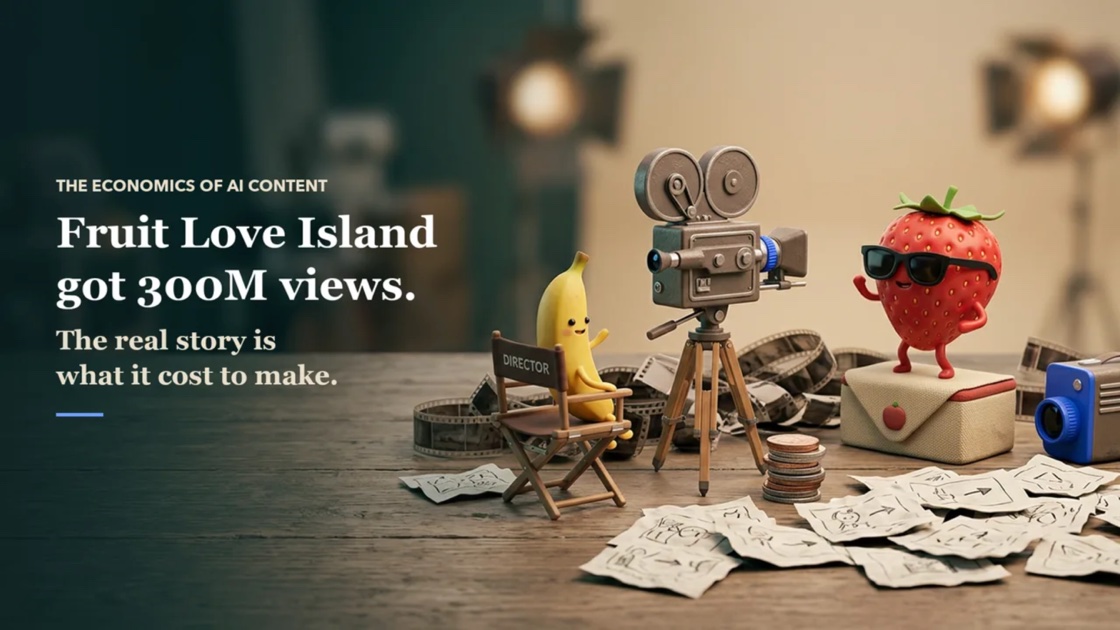
In March, a TikTok account called ai.cinema021 started posting a dating show where every contestant is a fruit. Strawberina flirts, Bananito sulks in an open shirt, and couples break up and re-couple in a villa that looks a lot like Love Island's. Within ten days the account had more than 3.3 million followers . Across 22 episodes of two to four minutes each, Fruit Love Island passed 300 million views , averaging over ten million per episode.
Then it fell apart about as fast. TikTok started removing episodes, and on March 28 the creator ended the series . ITV Studios, which distributes Love Island, said it would "take necessary steps to address unauthorised commercial use of our brand, trademark and assets." By then the format had spread anyway. Copycats appeared across Asia, a Korean fried-chicken chain made its own version and had to apologize , and fruit-drama topics on Douyin passed 23 million views .
You can call it AI slop, and plenty of people did. It's also the clearest demonstration yet of how cheap AI video has become: one anonymous creator made a show that pulled more than 300 million views in a few weeks. Asked how, the creator said: "I write the scripts, I plan the scenes and keep redoing things because the AI generation messes up constantly."
That last part, keep redoing things, is what this article is about. It decides whether an AI drama, or any AI product, makes money.
AI short drama is now an industry
The fruit show was one hit in a much bigger wave. In the first half of 2026, 221,900 new AI short dramas and animated series launched on Douyin . About 0.47% of them passed 100 million views. Platforms are paying to keep the supply coming: Hongguo, ByteDance's short-drama app, offers about ¥500,000 per S-grade AI drama , and Kuaishou offers traffic and revenue sharing for co-produced titles. One studio told an industry forum it produced 200 short dramas in a month with a small team.
So making content is cheap. Making a hit isn't. With a hit rate under half a percent, studios have to produce a lot, test fast, and spend real money only on the few titles that take off. That makes the cost of each episode the number they watch most closely.
What one episode actually costs
A Chinese creator whose fantasy series Guixu passed 200 million views told Cover News that 15 episodes of 8 minutes each cost him about ¥250,000 . "We're barely breaking even," he said. "Most of it went on rerolls." That works out to roughly ¥2,000 per finished minute, everything included. Chinese creators call rerolling chou ka, "drawing cards", because each generation is a gamble. One report estimates it can take five attempts to get one usable shot.
Here is a rough budget for one three-minute episode, which means 180 seconds of finished video, using video models available on OceanToken today. Prices are starting prices per second at the lowest resolution and mode; higher resolutions cost more. The five-tries figure comes from the report above. These numbers cover model costs only, which is why they come in well under the all-in budget of a professional series.
| Approach | Model | Tries per usable shot | Video cost per episode |
|---|---|---|---|
| Premium for every shot | google/veo-3.1 (from $0.18/s) | 5 | $162.00 |
| Premium, with better prompts | google/veo-3.1 | 3 | $97.20 |
| Mid-tier for every shot | bytedance/seedance-2.5 (from $0.0977/s) | 5 | $87.89 |
| Budget for every shot | bytedance/seedance-2.0-mini (from $0.0269/s) | 5 | $24.21 |
| Draft cheap, finish mid-tier | 4 drafts on seedance-2.0-mini, 1 final on seedance-2.5 | 4 + 1 | $36.95 |
Everything else in the episode is small change by comparison:
- Script and shot list: about 30,000 input and 20,000 output tokens on deepseek/deepseek-v4-pro ($1.056 / $3.168 per 1M) comes to roughly $0.10.
- Character sheets: 20 images on qwen/qwen-image-3 at $0.03 each is $0.60.
- Voice: about 2,500 characters of dialogue on fish-audio/s2-pro at $0.015 per 1,000 characters is about $0.04.
On the mid-tier row, video is about 99% of the bill, and the biggest lever is the number of tries rather than the price per second. Cutting retries from five to three on the premium model saves $64.80 an episode, about 90 times what the script, art and voice cost together. Over a 22-episode season, the gap between the top row ($3,564) and the budget row ($532.64) is enough to fund another show.
The "draft cheap, finish mid-tier" row is how many studios work. They try camera angles and timing on a fast, cheap model, then spend real money only on the takes they keep.
The same math applies to every AI app
Video makes the economics easy to see, but text-based AI products face the same problem.
In August, Stripe reportedly agreed to buy a service that routes developers' requests across hundreds of models, for a price reported above $7 billion . Three months earlier it had been valued at about $1.3 billion. A payments company paying that much for a routing layer tells you where the money in AI now sits: in deciding which model handles each request.
The pressure shows up in margins. Traditional software companies run at 70% to 90% gross margin. AI companies run at 50% to 60% , and ICONIQ found that inference takes about 23% of revenue at scaling AI B2B companies. Prices per token keep falling, by about tenfold a year for the same capability by a16z's estimate, but agents use far more tokens per task, so the total bill depends on routing.
Cheaper models are also winning share. Chinese open-weight models went from under 1.2% of weekly tokens on the largest public model router in late 2024 to somewhere between 30% and 60% in 2026, depending on how you count (Wing VC , Forkast ). Price is the reason most often given.
For a text workload of 10 million input and 2 million output tokens a month, here's the spread on OceanToken today:
| Model | Price per 1M tokens (in / out) | Monthly cost |
|---|---|---|
| openai/gpt-5.5 | $4.50 / $27.00 | $99.00 |
| anthropic/claude-opus-5.5 | $3.60 / $18.00 | $72.00 |
| anthropic/claude-sonnet-5.5 | $1.80 / $9.00 | $36.00 |
| google/gemini-3.8-flash | $0.675 / $3.375 | $13.50 |
| deepseek/deepseek-v4-flash | $0.21 / $0.84 | $3.78 |
| qwen/qwen3.7-flash | $0.03 / $0.13 | $0.56 |
The pattern is the same as with video. Send the routine 80% to a cheap model and the hard 20% to a strong one. Splitting this workload between deepseek/deepseek-v4-flash and anthropic/claude-opus-5.5 that way costs about $17.42 a month instead of $72.00.
How to choose your models
1. Break the work into steps
A drama is a script, character art, shots, voice and an edit. A support bot is intent detection, retrieval, an answer and sometimes a handoff. Each step can use a different model, and usually should. Writing a script and rendering a close-up are different jobs.
2. Price the result, not the call
For text, compare real tokens per request. Output usually costs two to eight times as much as input, and reasoning models add thinking tokens you don't see. For images and video, the unit that matters is the cost per usable result:
cost per usable result = price per try × number of tries
A model that's half the price per second but needs three times as many tries is the more expensive one.
3. Shortlist three models per step
| Step | Try first | Cheaper option | Premium option |
|---|---|---|---|
| Script and dialogue | deepseek/deepseek-v4-pro ($1.056 / $3.168) | qwen/qwen3.7-flash ($0.03 / $0.13) | anthropic/claude-sonnet-5.5 ($1.80 / $9.00) |
| Character and key art | qwen/qwen-image-3 ($0.03/image) | krea/krea-2-medium-turbo ($0.02) | bytedance-seed/seedream-5-0-pro ($0.09) |
| Video shots | bytedance/seedance-2.0 (from $0.0639/s) | bytedance/seedance-2.0-mini (from $0.0269/s), alibaba/wan-2.6 (from $0.04/s) | kwaivgi/kling-v3.0-pro (from $0.106/s), google/veo-3.1 (from $0.18/s) |
| Voice | fish-audio/s2-pro ($0.015 / 1K chars) | hexgrad/kokoro-82m ($0.00062) | minimax/speech-2.8-hd ($0.10) |
| Chat and support | google/gemini-3.8-flash ($0.675 / $3.375) | openai/gpt-6-luna ($0.09 / $0.45) | openai/gpt-5.5 ($4.50 / $27.00) |
| Coding agents | anthropic/claude-sonnet-5.5 ($1.80 / $9.00) | moonshotai/kimi-k2.7-code ($0.95 / $4.00) | anthropic/claude-opus-5.5 ($3.60 / $18.00) |
Text prices are per 1M input / output tokens; image prices are per image and voice prices per 1,000 characters. These are starting points to test on your own material, not a ranking.
4. Test with your own material and count the tries
Take 20 to 50 real inputs, such as scenes from your script or tickets from your queue. Run all three candidates with the same prompts. For text, score the answers. For video, also record how many generations each shot needs before you use it. Ship the cheapest option that meets your bar, keep the runner-up as a fallback, and re-run the test every quarter, because new models arrive every few weeks.
Running it on OceanToken
OceanToken puts nearly 500 models, including more than 30 video models, behind one API and one balance, so you can test every step of a production without opening five accounts. Video runs as a job: you submit it, poll its status, then download the file.
Make your own characters and format. The original drew a public warning from ITV Studios over unauthorized commercial use of the Love Island brand, and platforms removed many episodes. Label AI-generated content and follow each platform's rules.
Should I use one model for everything?
Usually not. Different steps need different strengths, and routine work to cheaper models is where most of the savings come from.
The bottom line
Fruit Love Island showed that one person with AI tools can reach hundreds of millions of viewers. Studios that do this for a living have learned the less visible lesson: the money is made or lost on retries and model choice. Break the work into steps, price the usable result instead of the single call, test three models per step, and keep the expensive ones for the shots that need them.
See every model and price on OceanToken → · Make your first request in the docs
Prices are OceanToken starting prices from the model catalog as of November 5, 2026, and every figure worked out from them follows the catalog whenever this page is rebuilt. Episode costs are estimates based on starting prices and the assumptions stated above.
More from the blog
AI Product Video Cost: The $2,000 NBA Finals Ad Took 400 Tries
An AI ad that aired during the NBA Finals cost $2,000 and took 300 to 400 generations. What 100 Black Friday ads cost with AI video, and how to spend less on retries.
Claude Code API Setup: What a Town of AI Coding Agents Taught Us
Developers now run Claude Code and Codex side by side. How to put both on one Claude Code API key setup, cap what each agent can spend, and add video, image and voice tools.