

Qwen Long Context: When to Fill 984K
Qwen long context in practice: Qwen3.8 lists a 984K-token window. When filling it pays off, when to chunk or retrieve, and a planted-fact test for your data.
By OceanToken Team
Editor's note: A window of almost a million tokens is a capability, not a strategy. Many teams reach for Qwen's full window to avoid building retrieval, then get surprised twice: by the bill, and by an answer that missed a fact buried mid-document. Treat the listed window as an upper bound and measure the part that works on your own data.
Short answer: Qwen long context on our catalog means a 984K-token window and 131K of output for qwen/qwen3.8-flash and qwen/qwen3.8-max-0902. Fill it for rare, high-value questions that need many documents at once. For repeated questions over the same corpus, retrieve and send a smaller prompt. Before relying on the full window, test recall on your documents.
What the Qwen long context window actually is
The OceanToken Qwen3.8 Flash model page and the Qwen3.8 Max page both list a context window of 983,616 tokens, which the pages round to 984K, and a maximum output of 131,072 tokens. Both take text, image and video input, and usage.prompt_tokens includes media, per the model docs .
Two details change how you plan a long call. First, the window is shared between your input and the reply, and the 131K figure caps the reply alone. Second, the docs say max_tokens includes reasoning tokens, and Alibaba Cloud's deep thinking guide lists both Qwen3.8 Flash and Max with "thinking mode enabled by default." On a long document, a model that thinks before answering can spend a real share of your output budget before it writes a word.
What public long-context research says
The usual "needle in a haystack" test hides one fact in filler text and asks for it back. It is easy to pass and says little about reasoning across a document. The RULER benchmark adds harder variants: several needles, multi-hop tracing where the model follows a chain of assignments, aggregation tasks such as listing the most frequent words, and question answering with distractors.
The RULER paper tested 17 models on 13 tasks. Most did well on the plain needle test and then declined sharply as length and task difficulty grew, and only about half held up at 32K tokens even though all claimed that length or more. Those are 2024-era models, so the numbers do not transfer to Qwen3.8. The warning does.
Lost in the Middle found that performance "is often highest when relevant information occurs at the beginning or end of the input context" and degrades when the model must use information in the middle. Newer models may have narrowed that gap. In the sources we checked, we did not find RULER-style results for Qwen3.8 published by the Qwen team, so measuring it yourself is the only way to know.
When filling the window earns its cost
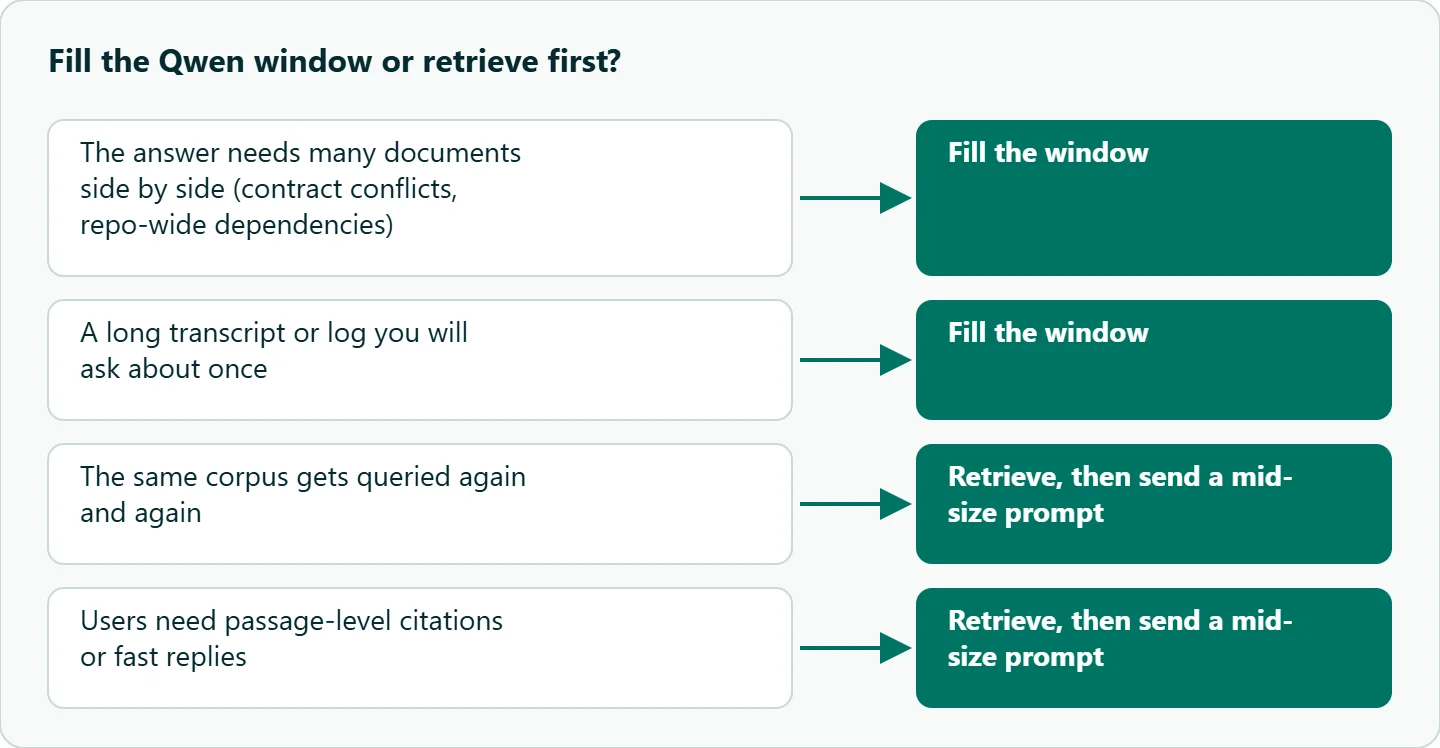
Long context is the right tool when the question needs many pieces of evidence side by side, and retrieval might never put them in the same prompt.
Cross-document reasoning is the clearest case: "Which of these 40 contracts conflict on termination terms?" A retriever ranks chunks by similarity to the question, and two conflicting clauses may not both rank high. Whole-repository questions, such as mapping dependencies before a migration, work the same way. So do long transcripts and logs that you ask about once, like a three-hour meeting or a day of service logs. And for one-off analysis, building and tuning an index can cost more effort than the question is worth.
When to chunk or retrieve instead
Retrieval wins whenever the same corpus is queried again and again. You index once and send a few thousand tokens per question instead of the whole corpus each time, so every call is faster and costs a fraction of a full-window call. It also wins when users need passage-level citations, since the retrieved chunks are your citations, and when latency matters: hundreds of thousands of input tokens take longer to process than a short prompt.
Cost is the deciding factor at scale. Input is billed per token, and a full-window prompt (about 984K tokens) sends roughly a hundred times the input of a 9K-token retrieved prompt, on every call. Work out your own number as prompt tokens times calls per day times the input rate on /qwen-api, and compare it with the cheapest long-context models if the window, not Qwen specifically, is what you need. Our Gemini 1M context vs RAG piece applies the same reasoning to another model family.
How to test this on your workload
The cheapest way to measure effective length is a planted-fact probe on your own text: insert a known fact at a chosen depth, ask for it, and record whether it comes back. Because the docs say parameters outside the table are dropped, and enable_thinking is not in the table, this probe leaves thinking at its default and logs reasoning tokens instead.
from openai import OpenAI

client = OpenAI(base_url="https://api.oceantoken.ai/v1", api_key="YOUR_OCEANTOKEN_KEY")
filler = open("your_corpus.txt", encoding="utf-8").read()

def probe(n_chars, depth, model="qwen/qwen3.8-flash"):
    # roughly 4 characters per English token; read u.prompt_tokens for the real size
    body = filler[:n_chars]
    needle = " The access code for vault 7 is 4417-QX. "
    pos = int(len(body) * depth)
    doc = body[:pos] + needle + body[pos:]
    r = client.chat.completions.create(
        model=model,
        messages=[{"role": "user", "content": f"{doc}\n\nWhat is the access code for vault 7? Quote the sentence."}],
        max_tokens=4000,  # includes reasoning tokens
    )
    u = r.usage
    return ("4417-QX" in (r.choices[0].message.content or ""),
            u.prompt_tokens, getattr(u.completion_tokens_details, "reasoning_tokens", None))

for depth in (0.05, 0.5, 0.95):
    print(depth, probe(400_000, depth))
Set sizes by checking prompt_tokens in the output, not by character count.
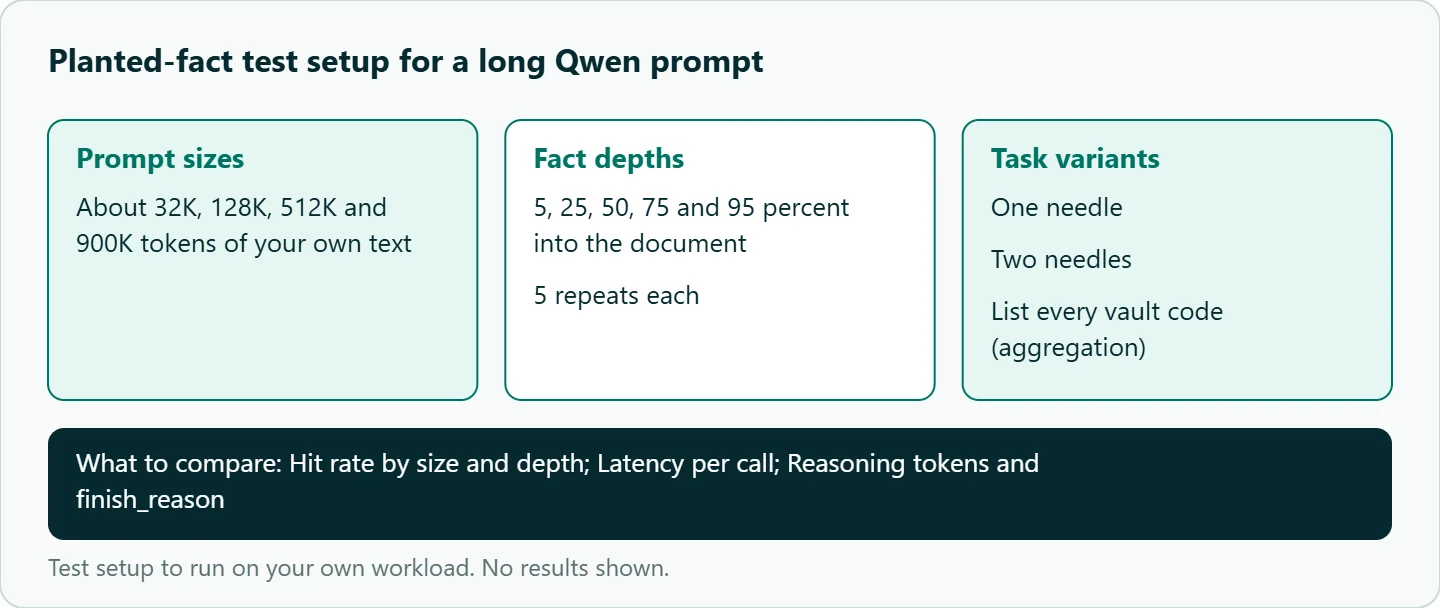
A useful run covers four prompt sizes (about 32K, 128K, 512K and 900K tokens), five depths (5, 25, 50, 75 and 95 percent) and five repeats each. Then add a two-needle variant and an aggregation variant ("list every vault code"), because passing a single needle says little about harder tasks. Record hit rate by size and depth, plus latency and reasoning tokens. We have not run this yet; when we do, we will publish the settings and results with dates.
What goes wrong with long prompts
Middle placement is the classic failure, so put the question both before and after the document and ask for a quote of the supporting sentence, which makes misses easy to spot. Near-duplicate clauses confuse the model inside a prompt just as they confuse a search index. A thinking model can run out of max_tokens on reasoning and return a truncated answer with finish_reason set to length, so check that field on every long call. And streaming helps users feel the wait less, though it does not shorten it.
Our take: Use the full Qwen window for low-volume, high-value questions that need many documents at once, and as a backstop when retrieval misses. For anything that repeats at scale, retrieval plus a mid-size prompt is cheaper, faster and easier to audit. Run the planted-fact probe before you trust any length above what you have tested.
Running it on OceanToken
Use qwen/qwen3.8-flash or qwen/qwen3.8-max-0902 with the base URL https://api.oceantoken.ai/v1. See the current rate on /qwen-api.
The /qwen-api page lists one OpenAI-compatible key with no Alibaba Cloud account needed, prepaid billing with no subscription, and "Failed requests are free," which matters when a long call times out. A refused request is not charged when your balance runs low, so an unattended long-document batch stops instead of running up a debt. Thinking-mode details are in our Qwen thinking guide.
FAQ
How large is Qwen's context window on OceanToken? Our catalog lists 983,616 tokens of context and 131,072 tokens of output for Qwen3.8 Flash and Qwen3.8 Max.
Is a bigger window always better? No. Cost and latency grow with length, and published research shows effective length often falls short of claimed length.
Should I use Max or Flash for long documents? Start with Flash and run the probe; move to Max only if task accuracy on your data justifies its higher rate.
Does thinking affect long-context calls? Yes. Alibaba lists thinking as on by default for both models, and reasoning counts toward max_tokens, so leave headroom.
Sources
- Hsieh et al.: RULER, arXiv:2404.06654 (checked 2026-11-11)
- NVIDIA: RULER repository (checked 2026-11-11)
- Liu et al.: Lost in the Middle, arXiv:2307.03172 (checked 2026-11-11)
- Alibaba Cloud Model Studio: Deep thinking (checked 2026-11-11)
- OceanToken: Qwen3.8 Flash model page (checked 2026-11-11)
- OceanToken docs: qwen/qwen3.8-flash (checked 2026-11-11)
- OceanToken Qwen API page (checked 2026-11-11)
Get your OceanToken API key
- Create an OceanToken account and an API key.
- Copy the snippet below, paste your key, and run it.
- Check the current rate on /qwen-api.
curl https://api.oceantoken.ai/v1/chat/completions \
  -H "Authorization: Bearer $OCEANTOKEN_API_KEY" \
  -H "Content-Type: application/json" \
  -d '{"model": "qwen/qwen3.8-flash", "max_tokens": 4000, "messages": [{"role": "user", "content": "Summarize the termination clauses in the contract below, then quote each one.\n\n<paste contract text>"}]}'
More from the blog
GPT-6 Luna Use Cases: What It Can Handle
GPT-6 Luna use cases: the scoped, high-volume jobs it fits, where to move up to Sol or Astra, its effort and tool-calling limits, and how to test the switch.
Qwen Commercial Use: Which License Applies
Qwen commercial use license, model by model: which Qwen weights are Apache 2.0, what the Qwen, research and Qwen3.8-Max licenses add, and API terms.
Seedance 2.0 Upscaled, Tested: Where 480p-to-4K Holds Up, and Where It Doesn't
Seedance 2.0 Upscaled from 480p to 720p, 1080p and 4K, tested: faces and fur hold up, signs and crowds don’t. Timing, prices and the API parameters.