

Qwen Commercial Use: Which License Applies
Qwen commercial use license, model by model: which Qwen weights are Apache 2.0, what the Qwen, research and Qwen3.8-Max licenses add, and API terms.
By OceanToken Team
Editor's note: "Qwen is open source" is true for many checkpoints and wrong for others, and the difference sits in one field on each model card. We'd check that field per model, never per family. The newest flagship shows why: Qwen3.8's small model is Apache 2.0, while its 2.4-trillion-parameter sibling ships under its own license with revenue thresholds. This article is not legal advice.
Short answer: The Qwen commercial use license depends on the exact checkpoint. Most Qwen3.x open weights, including Qwen3.8-27B, list Apache 2.0, which allows commercial use. Qwen3.8-2.4T-A95B uses the Qwen3.8-Max License, Qwen2.5-72B uses the Qwen License, and Qwen2.5-3B is non-commercial. Hosted API models follow the provider's terms.
Qwen commercial use license by model
We read the license field on each Hugging Face model card on November 10, 2026. The table covers the checkpoints people ask about most, not every repo Qwen has published.
| Model | License field on the card | Commercial use |
|---|---|---|
| Qwen3.8-27B | apache-2.0 | Yes, with Apache conditions |
| Qwen3.8-2.4T-A95B | qwen3.8-max | Yes, with thresholds (see below) |
| Qwen3.6-35B-A3B | apache-2.0 | Yes, with Apache conditions |
| Qwen3.5-397B-A17B | apache-2.0 | Yes, with Apache conditions |
| Qwen3-235B-A22B-Instruct-2507 | apache-2.0 | Yes, with Apache conditions |
| Qwen3-Embedding-8B | apache-2.0 | Yes, with Apache conditions |
| Qwen-Image | apache-2.0 | Yes, with Apache conditions |
| Qwen2.5-7B-Instruct | apache-2.0 | Yes, with Apache conditions |
| Qwen2.5-72B-Instruct | qwen | Yes, below 100M monthly users |
| Qwen2.5-3B-Instruct | qwen-research | No, research and evaluation only |
The bottom three rows are the reason to check per model. Three Qwen2.5 sizes carry three different licenses, so "Qwen 2.5 is Apache" is wrong for two of them.
What Qwen Apache 2.0 models allow
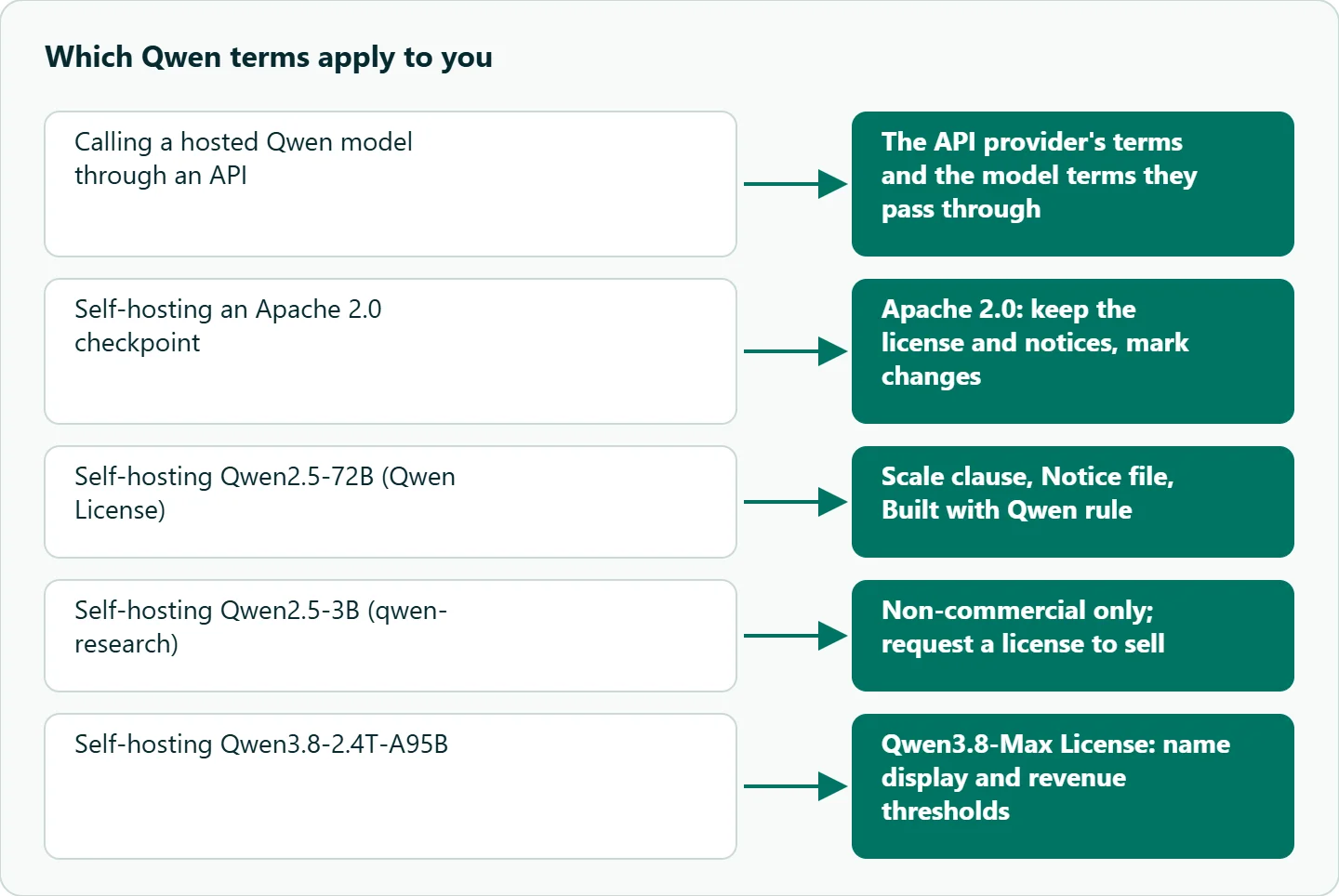
The Apache License 2.0 gives you a royalty-free right to copy, modify, sublicense and distribute the work, commercially included. When you redistribute, you include a copy of the license, mark files you changed, keep existing notices and carry over any NOTICE file. It also grants a patent license that ends if you sue claiming the work infringes a patent. It does not make you open-source your own application, and it gives no right to use the licensor's trademarks beyond describing where the work came from.
For most teams that means an Apache 2.0 Qwen checkpoint can sit inside a commercial product with very little paperwork, as long as nobody strips the license file on the way.
The Qwen3.8-Max License on the 2.4T weights
Qwen3.8 is where the "one family, one license" assumption breaks. The Qwen3.8-2.4T-A95B card lists the qwen3.8-max license, and its LICENSE file is permissive at its core, with two conditions on top:
- Name display. If your commercial product or service has more than 100,000,000 monthly active users or US$20,000,000 in monthly revenue, the model name must be prominently displayed in its user interface.
- Separate license for two business types. If you or your affiliates run a Model as a Service business (giving third parties inference or fine-tuning access, for example through an API) or an AI Work Assistant business (a standalone product built mainly for AI coding or office work), and aggregate revenue exceeds US$50,000,000 in any 12 consecutive months, you need a separate license from Qwen first. Internal use that does not expose the model or its outputs to third parties is exempt.
You must also keep the copyright and permission notice in all copies. We found no territorial restriction in the text, only a requirement to follow applicable laws. The card also says the hosted Qwen3.8-Max is "the official version based on" these weights, with extra features such as vision input and official built-in tools. Downloading the weights does not give you the hosted product, and calling the hosted product is governed by the provider's terms rather than the weights license.
What the Qwen License adds on Qwen2.5-72B
The Qwen License Agreement attached to Qwen2.5-72B-Instruct (release date September 19, 2024) allows commercial use, with these extra terms:
- Scale clause. Above 100 million monthly active users, you must request a license from Alibaba Cloud.
- Redistribution. Give recipients a copy of the agreement, mark modified files, and keep the attribution notices in a "Notice" text file.
- Naming rule. If you use the materials or their outputs to create, train, fine-tune or improve an AI model that you distribute or make available, display "Built with Qwen" or "Improved using Qwen" in the product documentation.
- Trademarks. No license to Alibaba Cloud's names or marks.
The naming rule is the one that catches teams. Distill a public 7B model from Qwen2.5-72B outputs and the rule applies to that release. With an Apache 2.0 teacher, it does not.
The qwen-research license on Qwen2.5-3B-Instruct is stricter. Its grant is for non-commercial purposes only, defined as research or evaluation, and commercial use requires requesting a license.
Self-hosting versus calling an API
Which document governs you depends on what you hold. If you download weights and run them, the license file in that repo at your pinned commit is the one that matters. If you call a hosted model, you never receive the weights, so the weights license is not what binds you. The provider's terms are.
On OceanToken, for example, the Terms of Service require you and your end users to follow the applicable model terms (section 4), say OceanToken claims no rights in output to the extent law and those terms allow (section 13), and bar reselling API access without consent (section 14).
Qwen3.8 Max (0902) on that page is a hosted model with a 984K context window. The license is written for Use of the downloaded Software; when you call a hosted model, the provider's terms and the model terms they pass through apply instead. If your case sits near a threshold, ask counsel. Features such as switching thinking on and off also live on the hosted side; our Qwen thinking mode guide covers those parameters.
| Your situation | Document to read |
|---|---|
| Internal tool on self-hosted weights | The repo's LICENSE file; log the commit |
| SaaS on self-hosted weights, users never get weights | LICENSE file, plus any scale or revenue clause |
| Shipping weights to a customer | LICENSE file and its redistribution and notice rules |
| Releasing a model trained on Qwen outputs | LICENSE file of the teacher model |
| Calling a hosted Qwen model | The API provider's terms and the model terms they pass through |
One case to flag for SaaS teams: if you self-host the Qwen3.8-2.4T-A95B weights and give third parties inference or fine-tuning access through an API or hosted endpoint, with meaningful control over inputs or parameters, that matches the license's Model as a Service definition, so the US$50,000,000 separate-license clause can apply to you. Merely relaying requests to models hosted by someone else is excluded.
Failure cases
Community re-uploads. A quantization or merge on someone else's account can carry a different license field, or the wrong one. Read the card of the repo you actually pull from.
Upgrades. A license on Qwen2.5 tells you nothing about Qwen3.8. Re-check on every model upgrade, because the family has already shown it will change terms between versions.
Card versus file. If the header field and the LICENSE file disagree, treat the file at your pinned commit as the document that counts, and record both.
A quick audit script
This reads the same license field shown on each card from the public Hugging Face model API. We have not wired it into a pipeline ourselves; treat it as a starting point.
import requests

models = ["Qwen/Qwen3.8-27B", "Qwen/Qwen3.8-2.4T-A95B",
          "Qwen/Qwen2.5-72B-Instruct", "Qwen/Qwen2.5-3B-Instruct"]
for m in models:
    meta = requests.get(f"https://huggingface.co/api/models/{m}", timeout=15).json()
    print(m, "->", meta.get("cardData", {}).get("license"), meta.get("sha"))
Store the license and the commit hash next to each deployment in your model registry. An audit a year later then takes minutes instead of a search through old chat threads.
Our take: For new self-hosted projects, default to an Apache 2.0 checkpoint such as Qwen3.8-27B unless a model with a custom license clearly wins your eval. The Qwen and Qwen3.8-Max terms are workable, but each adds a condition someone has to track. If you only need answers, not weights, calling a hosted model sidesteps the weights license and moves the question to the provider's terms.
Running it on OceanToken
Use base URL https://api.oceantoken.ai/v1 with qwen/qwen3.8-max-0902 or qwen/qwen3.8-flash, both listed on /qwen-api on November 10, 2026. See the current rate on /qwen-api.
The page says the API is OpenAI-compatible and only the base URL and the key change, with no Alibaba Cloud account, region or console to set up. One prepaid balance covers Qwen and the other model families, with no monthly fee, and failed requests are free. For a team that only needs Qwen's answers, that is often simpler than tracking a weights license at all, because the weights license does not apply, only the provider and model terms do.
FAQ
Is Qwen free for commercial use? Many Qwen open weights are, under Apache 2.0, but not all. Check the license field on the exact model card; Qwen2.5-3B-Instruct, for one, is research-only.
Can I fine-tune Qwen3.8-27B and sell the result? Its card lists Apache 2.0, which allows this if you keep the license and notices and mark changes. Confirm the file at the commit you used.
Does the Qwen3.8-Max License affect a startup? Rarely in practice. The name-display rule starts above 100 million monthly users or US$20 million monthly revenue, and the separate-license rule only covers large Model as a Service or AI Work Assistant businesses.
Does Apache 2.0 cover hosted Qwen API calls? No. Apache 2.0 governs weights you hold. A hosted call follows the provider's terms and the model terms they apply.
Do I own Qwen outputs? The Qwen and Qwen3.8-Max license files we read do not claim ownership of outputs. OceanToken's terms say it claims no rights in output to the extent law and the model terms allow, and do not promise output is protectable; that depends on local law.
Sources
- Hugging Face: Qwen3.8-2.4T-A95B model card (checked 2026-11-10)
- Qwen3.8-Max License (checked 2026-11-10)
- Hugging Face: Qwen3.8-27B model card (checked 2026-11-10)
- Hugging Face: Qwen3.6-35B-A3B model card (checked 2026-11-10)
- Hugging Face: Qwen3.5-397B-A17B model card (checked 2026-11-10)
- Hugging Face: Qwen3-235B-A22B-Instruct-2507 model card (checked 2026-11-10)
- Hugging Face: Qwen3-Embedding-8B model card (checked 2026-11-10)
- Hugging Face: Qwen2.5-7B-Instruct model card (checked 2026-11-10)
- Qwen License Agreement (Qwen2.5-72B-Instruct) (checked 2026-11-10)
- Qwen Research License Agreement (Qwen2.5-3B-Instruct) (checked 2026-11-10)
- Apache License 2.0 (checked 2026-11-10)
- OceanToken Terms of Service (checked 2026-11-10)
- OceanToken Qwen API page (checked 2026-11-10)
Get your OceanToken API key
- Create an OceanToken account and an API key.
- Copy the snippet below, paste your key, and run it.
- Check the current rate on /qwen-api.
curl https://api.oceantoken.ai/v1/chat/completions \
  -H "Authorization: Bearer $OCEANTOKEN_API_KEY" \
  -H "Content-Type: application/json" \
  -d '{"model": "qwen/qwen3.8-flash", "messages": [{"role": "user", "content": "Summarize the Apache 2.0 redistribution conditions in three bullets."}]}'
More from the blog
Qwen Long Context: When to Fill 984K
Qwen long context in practice: Qwen3.8 lists a 984K-token window. When filling it pays off, when to chunk or retrieve, and a planted-fact test for your data.
GPT-6 Luna Use Cases: What It Can Handle
GPT-6 Luna use cases: the scoped, high-volume jobs it fits, where to move up to Sol or Astra, its effort and tool-calling limits, and how to test the switch.
Seedance 2.0 Upscaled, Tested: Where 480p-to-4K Holds Up, and Where It Doesn't
Seedance 2.0 Upscaled from 480p to 720p, 1080p and 4K, tested: faces and fur hold up, signs and crowds don’t. Timing, prices and the API parameters.