

GPT-6 Luna Use Cases: What It Can Handle
GPT-6 Luna use cases: the scoped, high-volume jobs it fits, where to move up to Sol or Astra, its effort and tool-calling limits, and how to test the switch.
By OceanToken Team
Editor's note: We think Luna is the most underused model in the GPT-6 family. Teams send every call to a flagship out of habit, while a large share of production traffic is classification, routing and cleanup that a scoped model handles well. The catch is that "efficient" only helps when something checks the output. Give Luna jobs a machine can verify, and keep it away from jobs where a plausible wrong answer is expensive.
Short answer: The best GPT-6 Luna use cases are scoped, high-volume jobs with checkable output: routing, classification, field extraction, triage, short rewrites and fine-grained edits. Move a route up to GPT-6.1 Sol or GPT-6 Astra for ambiguous problems, deep analysis and long multi-step agent work. Start Luna at reasoning effort none.
What OpenAI says Luna is for
OpenAI's GPT-6 Luna model page calls it "our most efficient model for focused, high-volume tasks." The model selection guide is more concrete: Luna fits scoped tasks, triage and frequent automations, including fine-grained edits and simple data extraction, while Astra fits ambiguous problems, deep analysis and ambitious deliverables, and GPT-6.1 Sol sits between them for complex work where time and cost both matter.
| GPT-6 Luna (per OpenAI, checked November 10, 2026) | |
|---|---|
| Context window | 1,050,000 tokens |
| Max output | 128,000 tokens |
| Input / output | Text and image in, text out |
| Reasoning effort | none, low, medium, high, xhigh, max; default medium |
| Endpoints | Chat Completions, Responses, Batch |
| Features | Streaming, structured outputs, function calling |
A tier built for volume still has a million-token window and image input, which is what makes it more than a toy classifier. What it lacks is headroom on hard reasoning, so the job design has to supply the safety net.
Good first GPT-6 Luna use cases
These share one property: a wrong answer is cheap to detect.
| Job | Why it suits Luna | Check to put behind it |
|---|---|---|
| Intent routing | One decision from a fixed set | Label must be in the allowed list |
| Classification and tagging | Short output, repeated millions of times | Schema plus a spot-check sample |
| Field extraction into JSON | Answer is in the input text | JSON Schema validation |
| Pre-filtering spam or off-topic input | Mistakes go to a bigger model, not a user | Escalate anything uncertain |
| Short rewrites and fixes | Scoped, easy to review | Length and banned-term checks |
| Image triage (blurry, wrong product, has text) | Image input is supported | Human review of a sample |
Pair extraction and classification with structured outputs, so a free-text "Billing issue" never reaches code that expects billing. Our structured outputs tutorial covers the schema side, including checking for refusals and incomplete responses.
Where to move up a tier
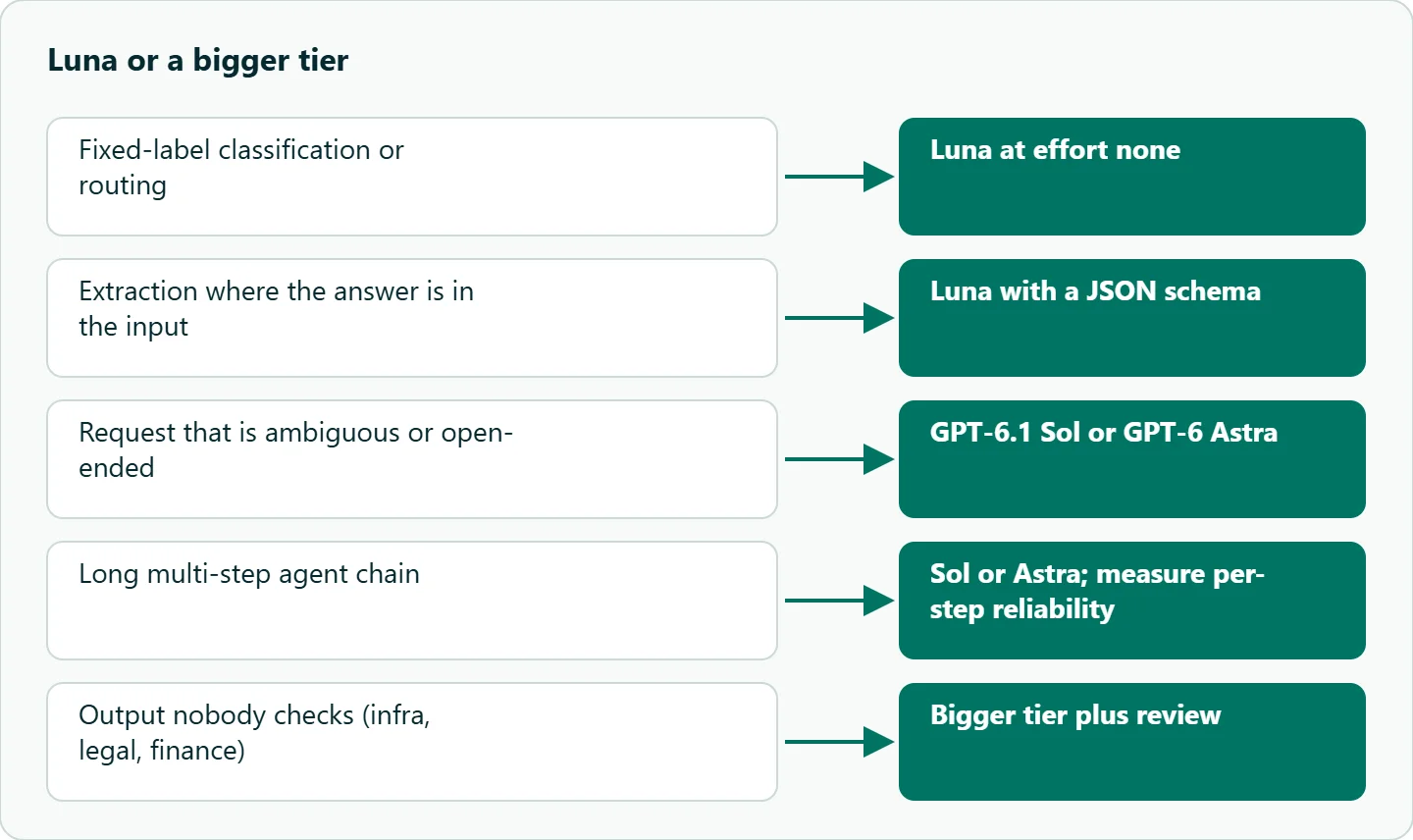
Send a route to Sol or Astra when the work stops being scoped:
- Ambiguous requests. If the job starts with working out what the user meant, a smaller model guesses more confidently than it should.
- Answers from memory. Give Luna the source text and ask it to quote. Don't let it answer facts from what it remembers in a customer-facing flow.
- Long agent chains. Errors compound across steps. As illustrative arithmetic, not a measured Luna number: if each step were right 95% of the time and steps failed independently, a five-step chain would finish cleanly only about 77% of the time (0.95^5). Per-step reliability is what to measure on a small model.
- Output nobody checks. Infrastructure manifests, legal text and financial figures that look valid but are wrong are the expensive failure mode. If no test or reviewer sits behind the output, use the bigger tier.
GPT-6 Luna limits on effort and tools
Effort is the dial that matters most on a model like this. OpenAI's reasoning guide says reasoning tokens are billed as output and count toward the output limit. On a label job, a thinking trace can be many times longer than the label itself. Start at none, which Luna supports, and move to low only if accuracy on your labeled set falls short.
Two limits change how you write the request:
- Tools in Chat Completions. The Using GPT-6 guide says GPT-6 Sol and GPT-6 Luna support function calling in Chat Completions only with
reasoning_effort: "none". An agent that wants both tools and reasoning needs the Responses API. - Sampling parameters. The same guide says that when effort is not
none, you should removetemperature,top_pandtop_logprobs.
If you cap output tokens tightly and leave effort at the medium default, the visible answer can come back empty because reasoning used the budget. Our empty-reply fix walks through that failure.
How to think about cost
Cost per route is tokens times rate, with reasoning tokens on the output side. That makes two levers matter more than the tier name. Effort comes first: on short-output jobs it can decide most of the output bill. Then prompt size, because a long system prompt repeated on every call adds up. For the current Luna, Sol and Astra rates, see /gpt-api, and compute your own route from logged usage numbers instead of an estimate.
How to test this on your workload
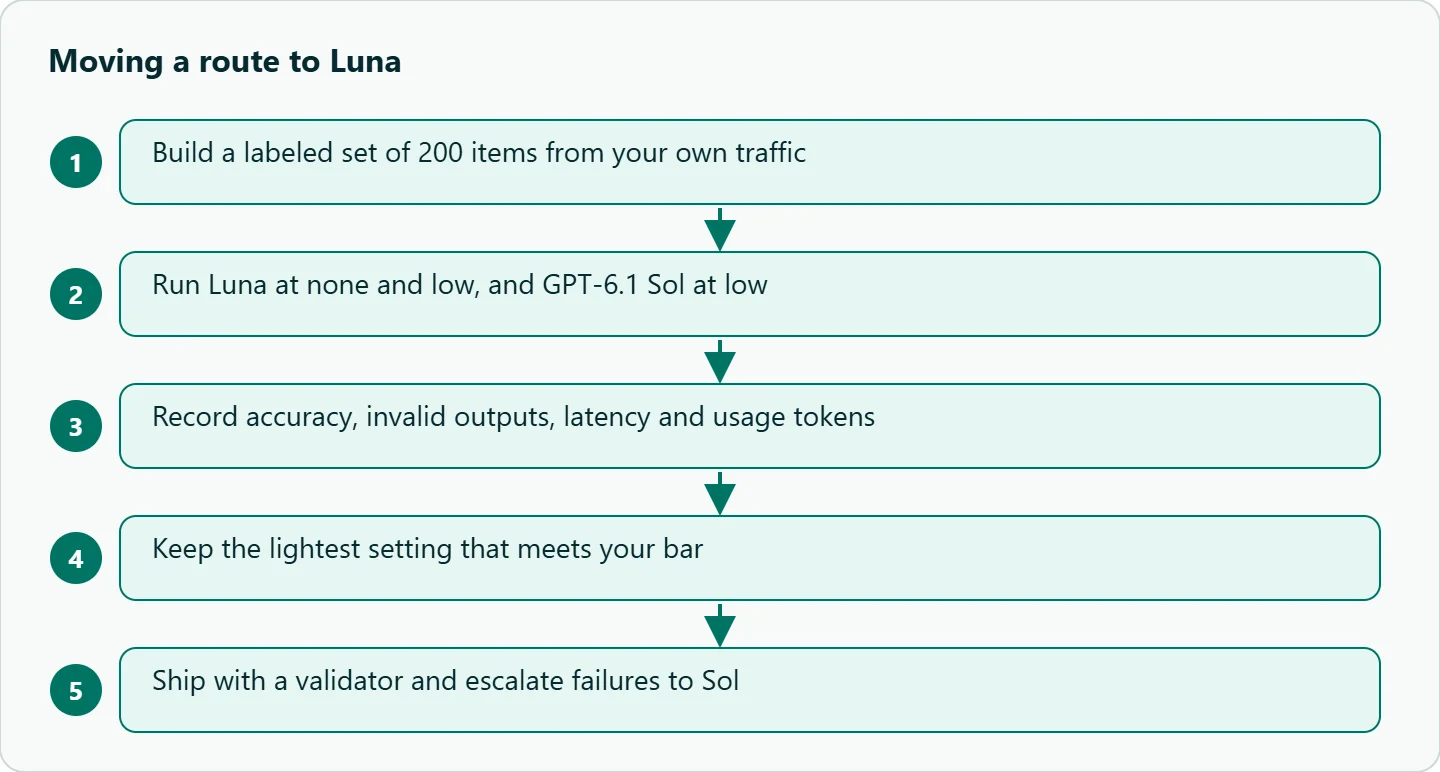
OpenAI's model selection guide suggests the method: set acceptance criteria first, compare models on the same inputs, repeat across representative tasks, vary effort with the model fixed, and keep the lightest setting that meets your bar.
- Build a labeled set of 200 items from your own traffic, including the awkward ones.
- Run Luna at
noneand atlow, and GPT-6.1 Sol atlow, on the same prompts. - Record accuracy, invalid outputs, latency and
usagetokens for each. - If Luna at
nonemeets the bar, ship it with a validator and an escalation path to Sol for anything that fails validation.
Our take: Treat Luna as the default for any route whose output a machine can check, and make the bigger tiers earn their place with an eval. Don't use Luna as the last line of defense for infrastructure, legal or financial output. The savings come from routing, not from hoping a small model behaves like a large one.
Running it on OceanToken
Use base URL https://api.oceantoken.ai/v1 with openai/gpt-6-luna; the /gpt-api page listed it with openai/gpt-6.1-sol and openai/gpt-6-astra on November 10, 2026. Its model docs list reasoning_effort values none, low, medium, high and max (default medium), tools and json_schema output. xhigh, which OpenAI lists for Luna, is not in that list. Parameters a model doesn't accept are dropped rather than rejected, so a request with xhigh falls back to the default medium, and you should check the usage numbers on a few calls to confirm none took effect.
from openai import OpenAI
client = OpenAI(base_url="https://api.oceantoken.ai/v1", api_key="YOUR_OCEANTOKEN_KEY")

LABELS = ["billing", "bug", "feature_request", "other"]
def classify(text):
    r = client.chat.completions.create(
        model="openai/gpt-6-luna",
        reasoning_effort="none",
        messages=[{"role": "system", "content": f"Reply with exactly one label from {LABELS}."},
                  {"role": "user", "content": text}],
        max_completion_tokens=10,
    )
    label = r.choices[0].message.content.strip()
    return label if label in LABELS else "other"

print(classify("I was charged twice this month"))
The page says any OpenAI-compatible SDK works with the new base URL and key, billing is prepaid with no subscription, and each API key can have its own spending limit, which is a useful guard on a high-volume route. On OceanToken, escalating a route to Sol is a model id change on the same key. See the current rate on /gpt-api.
FAQ
What is GPT-6 Luna good for? Scoped, high-volume work with checkable output: routing, classification, extraction, triage and short edits, per OpenAI's model selection guide.
Can Luna call tools? Yes, but in Chat Completions only with reasoning_effort set to none. For tools plus reasoning, OpenAI points to the Responses API.
Does Luna accept images? Yes. OpenAI lists text and image input with text output.
What context window does Luna have? OpenAI lists a 1,050,000-token context window and up to 128,000 output tokens.
When should I pick Sol over Luna? When the route involves ambiguity, multi-step reasoning or output nobody verifies, or when your labeled eval shows Luna missing your bar.
Sources
- OpenAI: GPT-6 Luna model page (checked 2026-11-10)
- OpenAI: Using GPT-6 (checked 2026-11-10)
- OpenAI: Model selection (checked 2026-11-10)
- OpenAI: Reasoning models (checked 2026-11-10)
- OceanToken docs: openai/gpt-6-luna (checked 2026-11-10)
- OceanToken GPT API page (checked 2026-11-10)
Get your OceanToken API key
- Create an OceanToken account and an API key.
- Copy the snippet below, paste your key, and run it.
- Check the current rate on /gpt-api.
curl https://api.oceantoken.ai/v1/chat/completions \
  -H "Authorization: Bearer $OCEANTOKEN_API_KEY" \
  -H "Content-Type: application/json" \
  -d '{"model": "openai/gpt-6-luna", "reasoning_effort": "none", "max_completion_tokens": 10, "messages": [{"role": "system", "content": "Reply with exactly one label: billing, bug, feature_request, other."}, {"role": "user", "content": "I was charged twice this month"}]}'
More from the blog
Qwen Long Context: When to Fill 984K
Qwen long context in practice: Qwen3.8 lists a 984K-token window. When filling it pays off, when to chunk or retrieve, and a planted-fact test for your data.
Qwen Commercial Use: Which License Applies
Qwen commercial use license, model by model: which Qwen weights are Apache 2.0, what the Qwen, research and Qwen3.8-Max licenses add, and API terms.
Seedance 2.0 Upscaled, Tested: Where 480p-to-4K Holds Up, and Where It Doesn't
Seedance 2.0 Upscaled from 480p to 720p, 1080p and 4K, tested: faces and fur hold up, signs and crowds don’t. Timing, prices and the API parameters.