

Kling Character Consistency Across Shots
Kling character consistency across shots: reusable references, image-to-video from fixed stills, a locked identity line, and motion control, with trade-offs.
By OceanToken Team
Editor's note: We think character consistency is a workflow problem, not a model setting. No single switch keeps a face identical across ten clips. What works is deciding up front how identity is carried, by a reference, by a fixed first frame, or by words, and accepting that words are the weakest anchor. We have not run an identity test on Kling yet, so the ranking below is reasoning from documented features, with a test plan attached.
Short answer: Partly. For Kling character consistency, carry identity with references (reference images, or a reusable subject on Kling 3.0), or start each shot from a still of the character with image-to-video. Repeat one locked identity line in every prompt as a supplement. Expect small drift in clothing details and accessories even then.
What Kling offers to keep a consistent character
Kuaishou's Kling 3.0 launch release says Video 3.0 has "improved element consistency, enabling creators to upload reference videos and multiple image references," and that Video 3.0 Omni can use a reference video to "extract visual traits and voice characteristics of a character."
On OceanToken, the Kling 3.0 request schemas give you four handles, checked on November 9, 2026:
| Handle | kling-v3.0-pro / -std | kling-v3.0-omni |
|---|---|---|
Reference images (input_references) |
Up to 6 | Up to 7, plus 1 video |
Reusable subjects (subjects) |
Up to 3 | Up to 7 |
First and last frames (frame_images) |
Yes | Yes |
| Clip length | 3 to 15 s | 3 to 15 s |
Subjects are created once with POST /v1/videos/subjects (the fields are in each model's request schema ), then passed by id in subjects as {"id": "subject_..."} on later requests. The schema notes they only work for the account that created them. This page is about strategy across shots, so it leaves the subject parameters themselves aside.
Four ways to carry identity, ranked by control
1. A reusable reference (strongest)
For a Kling consistent character across many clips, define them once and reuse that definition. On Kling 3.0 that means a set of reference images, or a subject built from them, attached to every request. The model sees the same evidence each time instead of reinterpreting a paragraph of text. On Omni, the release adds a reference video as a source of both look and voice.
2. Image-to-video from consistent stills
Make the character in an image model first, then start each shot from a still of them in the pose you need, using frame_images with frame_type set to first_frame. Identity is fixed at frame zero, and you can check it before spending anything on video. It can still drift during the clip, more so in long clips and when the face turns away.
3. A locked identity line
Write one line, roughly age, hair, one unusual feature and the outfit, and paste it unchanged into every prompt. "A young chef in a navy apron, short curly hair, a small scar through the left eyebrow." Never paraphrase it between shots. It costs nothing, but it is the weakest anchor on its own, so treat it as a supplement to 1 or 2.
4. Motion control, for performance
motion_control on Kling 3.0 Pro and Standard applies the movement in a video to a character image. The image supplies the person; the video supplies the acting. It suits the case where the same character must perform specific choreography. The schema limits it to accounts cleared for real-person media.
| Method | Identity hold (expected) | Effort | Best for |
|---|---|---|---|
| Reusable reference | High | Low once built | A recurring hero |
| Image-to-video from stills | High at the first frame | Medium | Exact outfits and poses |
| Locked identity line | Low on its own | None | Quick one-offs, as a supplement |
| Motion control | High, copies motion | High | Matching a performance |
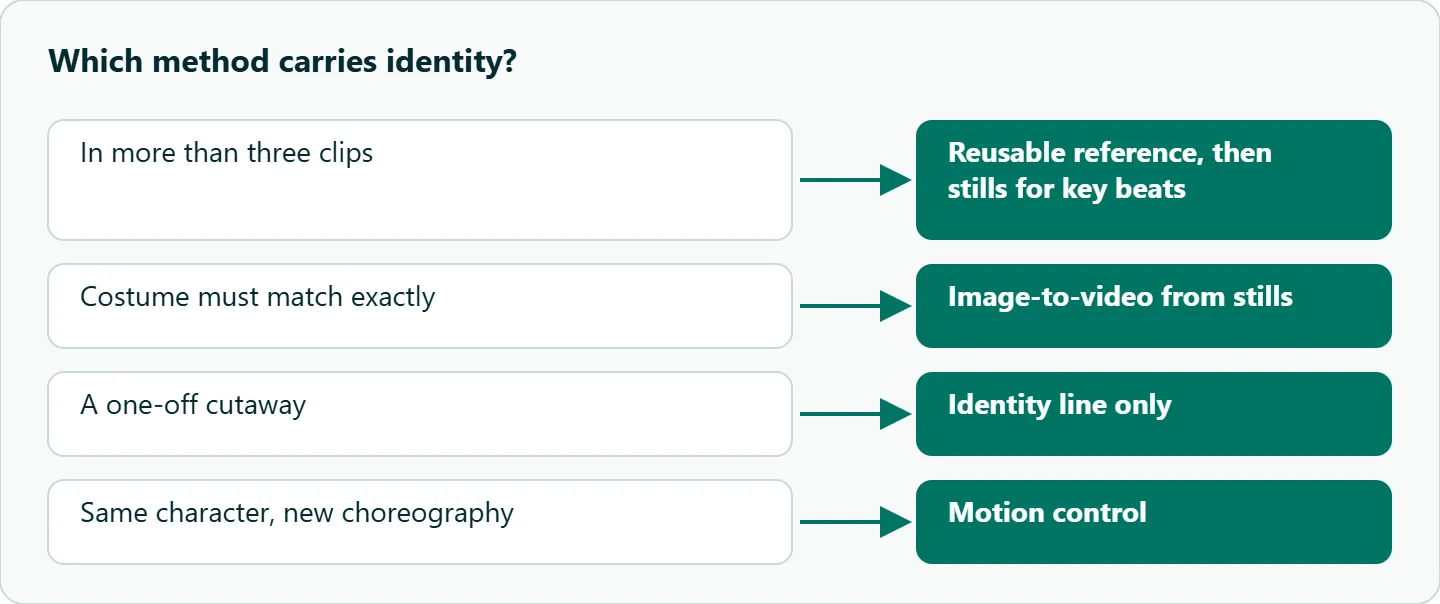
Kling character consistency: which method for which job
| Situation | Use |
|---|---|
| The character appears in more than three clips | A reusable reference, then stills for key beats |
| Two characters in one shot | A separate reference for each, one role each |
| A costume must match a brand sheet exactly | Image-to-video from stills |
| A one-off cutaway | The identity line only |
| The same character, new choreography | Motion control |
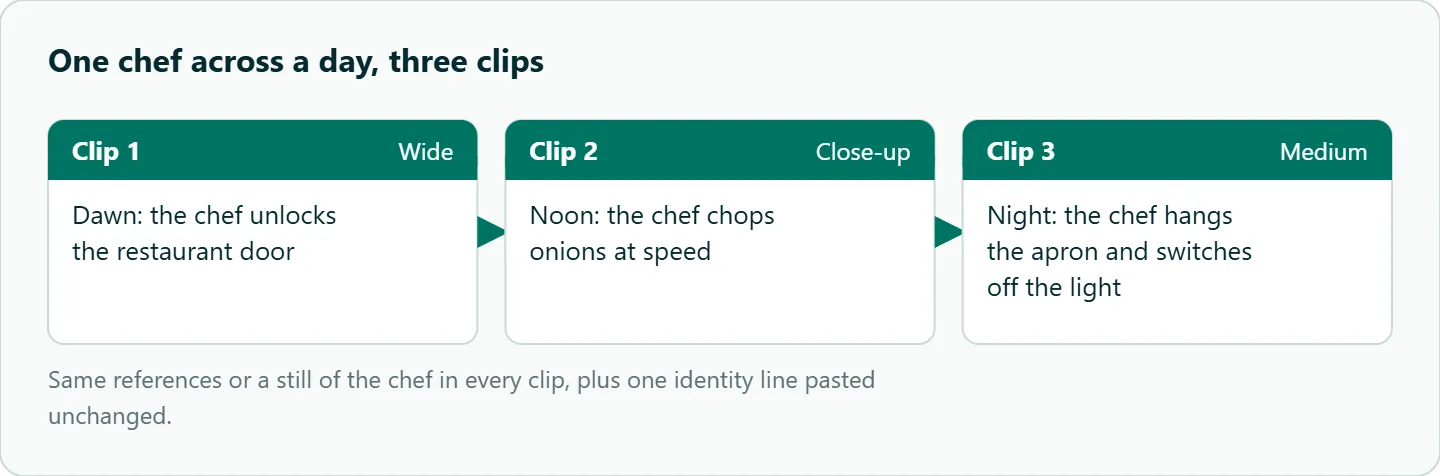
A simple practice sequence: the same chef across one day, three separate clips. Attach the same references to each, or start each from a still of the chef, and paste the identity line into all three.
Clip 1: Dawn. Wide shot, the chef unlocks the restaurant's front door.
Clip 2: Noon. Close-up, the chef chops onions at speed.
Clip 3: Night. Medium shot, the chef hangs the apron on a hook and switches off the light.
Identity line in every clip: A young chef in a navy apron, short curly hair, a small scar through the left eyebrow.
Building the character once
Generate two to four clean images of an invented character: a close front view, a three-quarter view, a full-body view. Use a plain background and even light, so the references carry the person and not the room. Fix the outfit; if the story needs a change of clothes, build a second reference set rather than asking one to cover both.
Use invented characters. The Kling v3.0 Pro model page says the maker's content rules can refuse some images, and to only use photos of real people you have the right to use, with that person's consent.
What still drifts
Small, high-frequency details drift first: buttons, logos on clothing, jewelry, hair partings, tattoos. Crop the problem detail into an extra reference image, avoid close-ups on it, or fix it in post. Faces at extreme angles, seen from above or in full profile, are the next risk. Longer clips give drift more room, so split long actions into shorter shots that each carry the references again.
How to test this on your workload
We have not measured identity hold on Kling, so score it yourself. A simple rubric: compare the same crop across clips and score face, hair, outfit and one accessory from 0 (different) to 2 (same), giving 0 to 8 per clip.
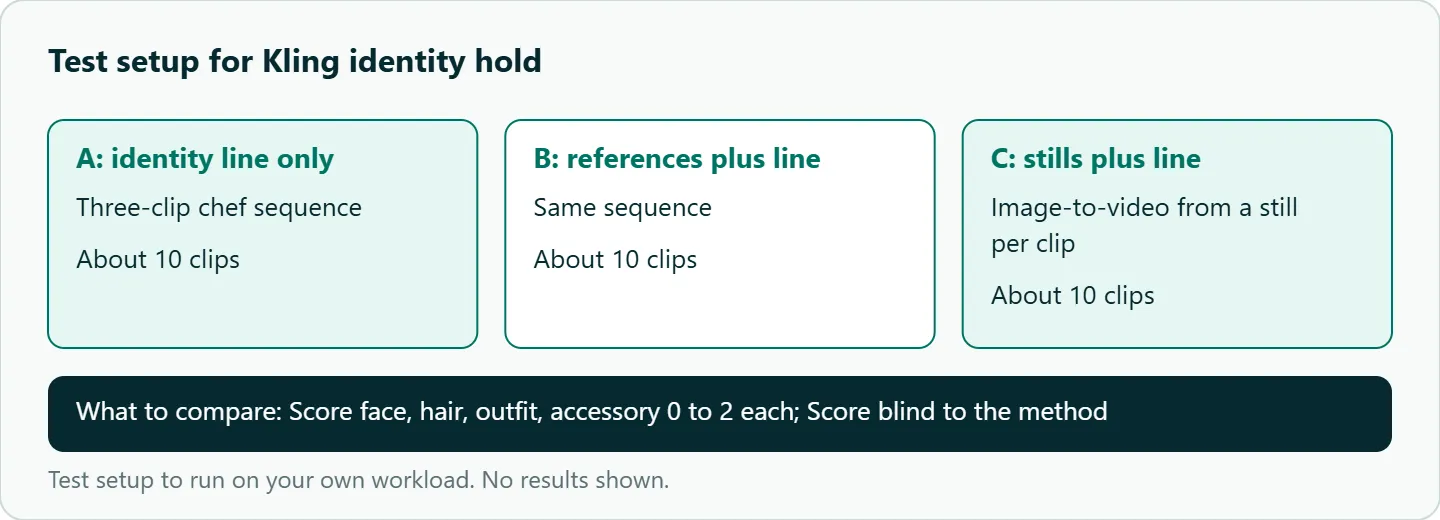
- Pick one invented character and the three-clip chef sequence.
- Run it with the identity line only, with reference images plus the line, and with image-to-video from stills plus the line.
- Make about ten clips per method if you can, on
kwaivgi/kling-v3.0-stdat 5 seconds. - Score blind: have someone who does not know the method do the scoring.
Our take: If a character appears in more than three clips, build a reference set once. The hour spent is cheaper than re-rolling clips until a face matches, and it turns identity from a hope into an input.
Running it on OceanToken
Kling 3.0 is kwaivgi/kling-v3.0-pro (1080p), kwaivgi/kling-v3.0-std (720p) or kwaivgi/kling-v3.0-omni at https://api.oceantoken.ai/v1; all are listed on /kling-api. Draft on Standard, re-render keepers on Pro, and use Omni when you want a reference video in the mix.
The API is OpenAI-compatible, so you change the base URL and key and keep your code. Each key can have its own spending limit, which helps when a consistency test runs dozens of clips. Refused or failed video jobs are not charged. One prepaid balance with no subscription covers Kling and the image models you would use to build the character. For batch runs, the Kling n8n workflow (and Make) post covers create, poll and download. See the current rate on /kling-api.
FAQ
Can Kling keep the same character across shots? Partly. References or a fixed first frame hold identity much better than text alone, but small details still drift.
How many reference images can I use? On OceanToken's Kling 3.0 schemas, up to 6 on Pro and Standard and up to 7 on Omni.
Does image-to-video keep faces? Better than text, because the first frame fixes the face. It does not guarantee the face holds for the whole clip.
Can I keep the same voice? Kuaishou says Video 3.0 Omni can extract voice characteristics from a reference video. Test it on your own character.
Are 15-second clips safe from drift? No. Longer clips give drift more room; split into shorter shots that each carry the references.
Sources
- Kuaishou: Kling AI launches 3.0 model (GlobeNewswire) (checked 2026-11-09)
- OceanToken docs: Kling v3.0 Pro request schema (checked 2026-11-09)
- OceanToken docs: Kling v3.0 Standard request schema (checked 2026-11-09)
- OceanToken docs: Kling v3.0 Omni request schema (checked 2026-11-09)
- OceanToken: Kling v3.0 Pro model page (checked 2026-11-09)
- OceanToken Kling API page (checked 2026-11-09)
Get your OceanToken API key
- Create an OceanToken account and an API key.
- Copy the snippet below, paste your key, and run it.
- Check the current rate on /kling-api.
curl https://api.oceantoken.ai/v1/videos \
  -H "Authorization: Bearer $OCEANTOKEN_API_KEY" \
  -H "Content-Type: application/json" \
  -d '{"model": "kwaivgi/kling-v3.0-std", "prompt": "Dawn. Wide shot, a young chef in a navy apron, short curly hair, a small scar through the left eyebrow, unlocks the restaurant door.", "duration": 5, "frame_images": [{"type": "image_url", "frame_type": "first_frame", "image_url": {"url": "https://example.com/chef-still.jpg"}}]}'
More from the blog
A Unified API for Chat, Image and Video
Building on a unified API for chat, image and video: sync vs async calls, billing units, retries, timeouts and storage, with three calls and a launch checklist.
Kimi K3 API International Access Guide
Use the Kimi K3 API internationally: sign up with email, pay by card, create one key and call moonshotai/kimi-k3 with an OpenAI SDK. Steps, code and checks.
Call Tencent Hy3 With the OpenAI SDK
Call Tencent Hy3 with the OpenAI SDK outside China: base URL, model id, streaming, tool calls, reasoning_effort values, Hy3 vs Hy3 preview, and token billing.