

Hailuo Video Generation in n8n and Make
No-code Hailuo video generation in n8n or Make: a shot-list sheet, create and poll steps, per-model checks for H3 and Hailuo 2.3, and which platform fits whom.
By OceanToken Team

Editor's note: Video generation is slow, so the hard part of automating it isn't the API call. It's the waiting, and what happens to a half-finished job when the workflow restarts. Our view: build the spreadsheet first. A row per shot, a status column and a human approval step make a sturdier pipeline than any clever single workflow, and they work the same in n8n and Make.
Short answer: For n8n Hailuo video generation, keep a sheet with one row per shot. One workflow sends POST /v1/videos and saves the job id; a second, scheduled one checks GET /v1/videos/{id} until completed or failed, saves the MP4 to your storage and asks a human to approve. Make works the same way, built as two scenarios.
Why a Hailuo pipeline needs a sheet, not just a workflow
A Hailuo clip takes minutes, not seconds. OceanToken's video guide says a clip "usually takes a few minutes" and recommends checking every 10 to 20 seconds. A job moves from queued to in_progress and ends completed or failed; a completed job has a content_url that's valid for 24 hours.
Hold one job in a workflow for minutes and every restart, deploy or timeout becomes a question: was the clip created, and do we have it? A sheet answers that. Each row stores the job id the moment the create call returns, so any later step can fail and rerun without ordering a second render.
The sheet also carries the creative plan. These columns cover most teams:
| Column | Example | Why it's there |
|---|---|---|
shot_id |
teaser-03 |
Row key |
attempt |
1 | With shot_id, forms the idempotency key |
model |
minimax/hailuo-3 |
Lets one sheet mix models |
prompt |
"Tracking shot, feet only: a runner sprints on a track at dawn" | The shot |
duration |
6 | Checked against the model's options |
first_frame_url |
Previous shot's approved last frame | Chains shots together |
job_id, status |
Filled by the workflow | Resume point |
file_link, approved |
Filled on success, then by an editor | Review gate |
This page is about wiring jobs together in automation tools; for the video models themselves, compare them on the video generation models page. If you prefer code to nodes, our Hailuo async flow in Python runs the same create, poll and download cycle in a script.
Check each row against the Hailuo model first
The two main Hailuo ids accept quite different options, and a sheet that mixes them will produce refusals unless you check rows before submitting. From OceanToken's request schemas on November 10, 2026:
| Option | minimax/hailuo-3 |
minimax/hailuo-2.3 |
|---|---|---|
| Duration | 5 to 15 s | 6 or 10 s |
| Resolution | 2K | 1080p |
| Aspect ratio | 21:9, 16:9, 4:3, 1:1, 3:4, 9:16, adaptive | 16:9 only |
| Frames | First and last | First only |
| References | Up to 9 images, 3 videos, 3 audio | Not listed |
A 9:16 row for social on Hailuo 2.3 is the classic mistake. Unsupported values are refused with 400 invalid_request before anything runs or is charged, and the message lists what's allowed, so nothing is lost but the row fails.
Better still, start the create workflow with an HTTP step that calls GET https://api.oceantoken.ai/oceantoken/video/model-spec?model={{row.model}} (an n8n expression, or a mapped field in Make), so each row is checked against its own model, and filter out rows outside the returned durations and aspect ratios. One call per model is enough; cache the result for the run. A 400 costs nothing, so what this saves is the failed rows and the time spent working out why they failed. Also write the x-oceantoken-dropped-params response header into the row: it names any optional field the request ran without.
Shot chaining depends on the model too. Hailuo 3 accepts both a first and a last frame, so you can pin where a shot starts and ends. Hailuo 2.3 takes a first frame only.
n8n Hailuo video generation: create, then poll
Workflow 1 is triggered by new rows with an empty job_id. An HTTP Request node posts to https://api.oceantoken.ai/v1/videos with model, prompt, duration and, when present, frame_images. Store the key as an n8n credential: the HTTP Request node docs support a generic Header Auth credential for services without a built-in one. Add an Idempotency-Key header built from shot_id and attempt, such as teaser-03-1; the video guide says a retried create with the same key returns the existing job instead of starting and charging another. Then write job_id and status = submitted back to the row.
The attempt part of the key matters when a job fails. Reusing the old key would just return the failed job, so a retry needs attempt raised by one; Workflow 2 below does that and hands the row back to Workflow 1.
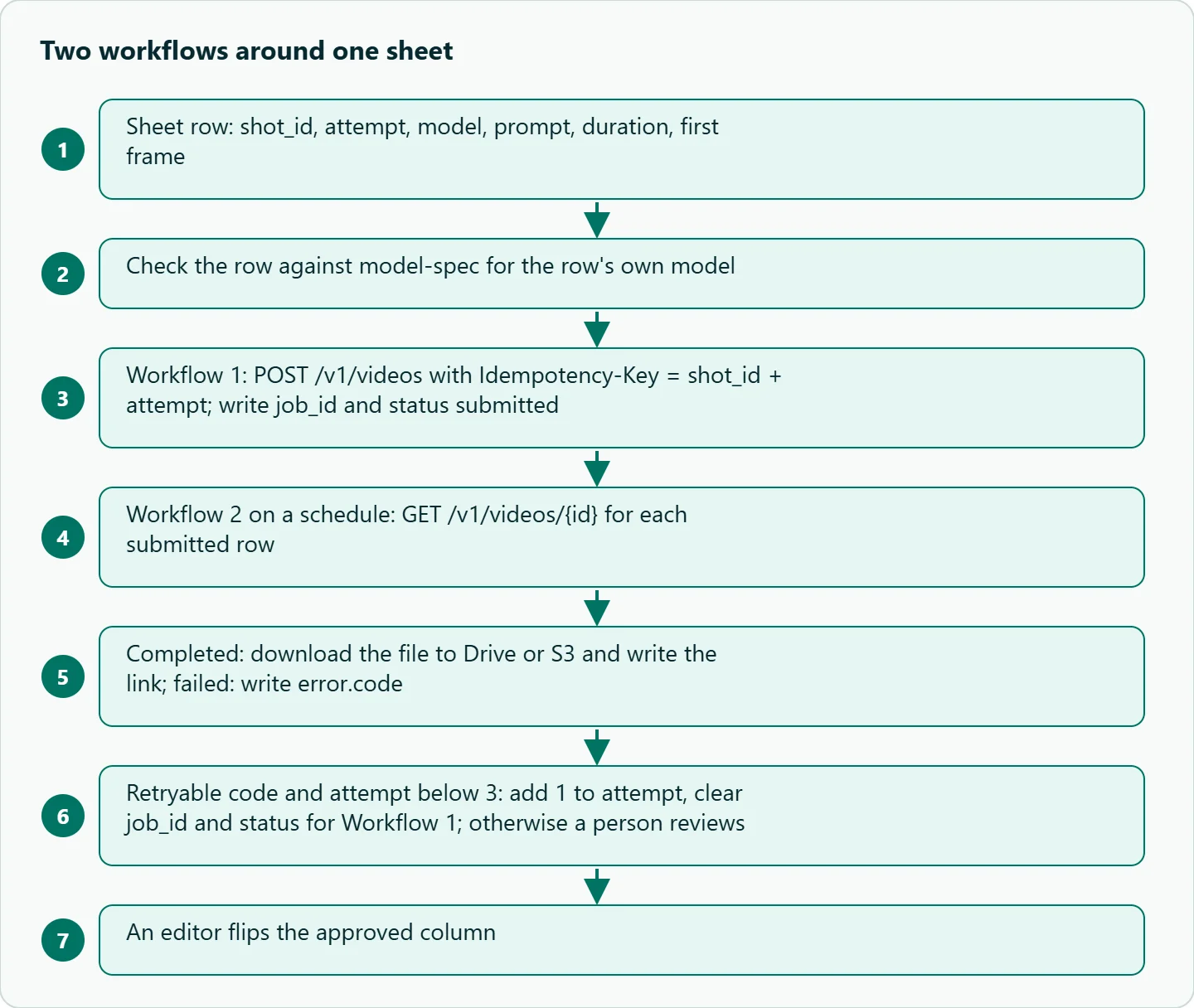
Workflow 2 runs on a Schedule Trigger, reads rows with status = submitted, and checks each job. A Switch node routes on status. For completed, a second HTTP Request node calls /v1/videos/{id}/content with Response Format set to File, and the next node uploads the file to Drive or S3.
For failed, write error.code to the row, then branch on it. The video guide says to resubmit after rate_limited, timeout, temporarily_unavailable and generation_failed, so for those codes, if attempt is below 3, add 1 to attempt and clear job_id and status; Workflow 1 then picks the row up again with a new key. At attempt 3, or for content_filtered and invalid_request, which fail the same way on a rerun, set status = needs_review for a person to fix the prompt or settings.
The node's Batching option (items per batch and an interval between batches) keeps a 40-row check from firing 40 requests at once.
If you want faster turnaround than a scheduled run, a short loop with a Wait node works. n8n's Wait node docs say waits under 65 seconds keep the execution in memory; longer waits are offloaded to the database and resumed. A 15-second wait in a capped loop is fine. Cap the attempts so a stuck job can't hold an execution indefinitely.
Hailuo in Make: two scenarios from the start
Make's limits push you toward the split design whether you planned it or not. The Make Tools docs say the Sleep module pauses for up to 300 seconds and suggest splitting longer waits into two scenarios that pass data through a data store. A Hailuo render can outlast one Sleep, so don't build a single scenario that sleeps until the clip is ready.
Scenario 1 watches the sheet and uses the HTTP app's "Make a request" module for the create call. Make's HTTP app docs say to put the API key in the Credentials field through a keychain rather than in a header, to set the body type to JSON, and to turn on Parse response so the returned id can be mapped back to the row.
Scenario 2 is scheduled, searches for submitted rows, checks each job, and uses a Router for completed and failed. The "Download a file" module fetches the MP4. The failed route needs the same retry path as in n8n: for the four retryable codes, while attempt is below 3, add 1 to attempt and clear job_id and status so Scenario 1 resubmits the row; otherwise, and always for content_filtered and invalid_request, mark the row for a person.
One setting matters for error handling. With "Return error if HTTP request fails" on, any 4xx or 5xx stops the run. That's right for a 401 from a bad key, but a 400 on one row shouldn't stop the whole batch, so add an error handler on that module that writes the error to the row and carries on.
n8n or Make: which to pick
Both can run this pipeline; the choice is mostly about where your team already works and how much waiting you need.
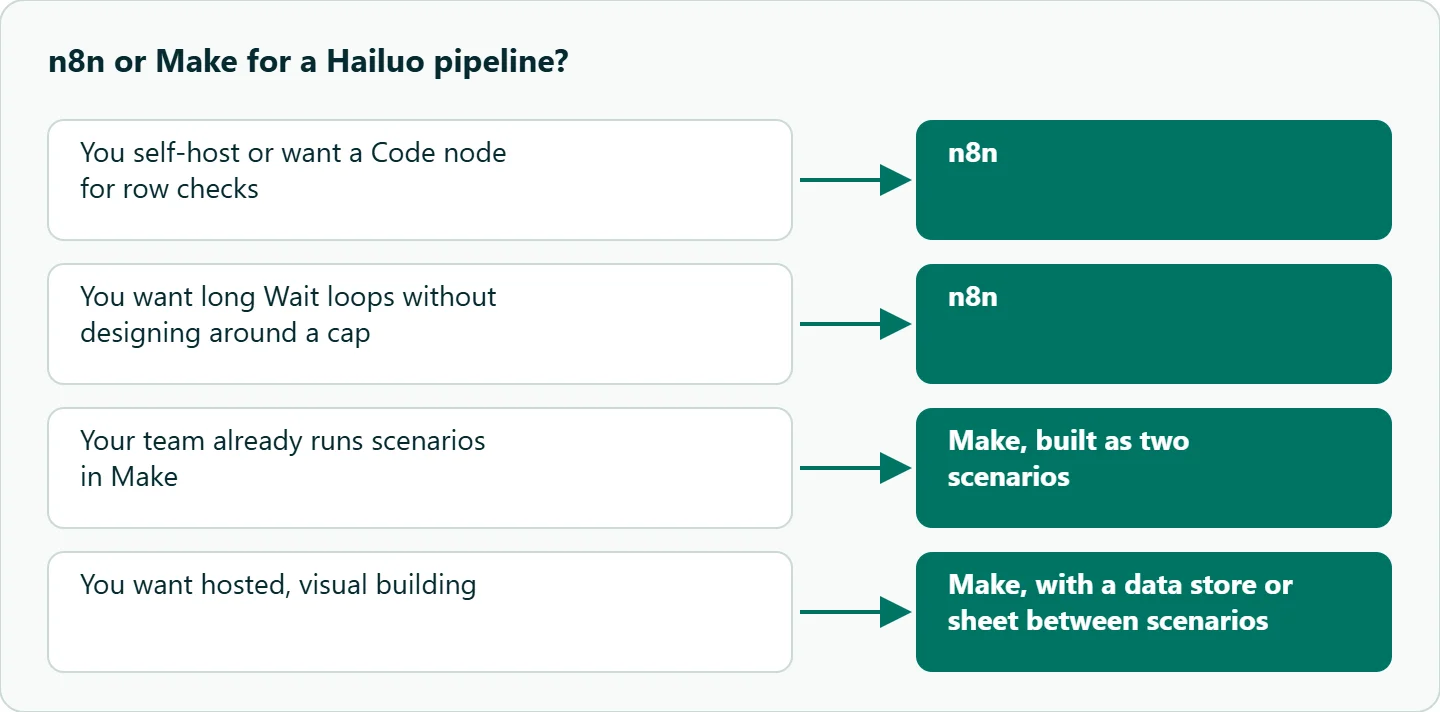
Pick n8n if you self-host, want a Code node for row validation, or want long Wait loops without designing around a cap. Pick Make if your team already runs scenarios there and wants hosted, visual building; accept from day one that it's two scenarios and a data store or sheet. If you're choosing fresh and a developer will maintain it, n8n's Code node makes the per-model checks easier to keep in one place.
Going native instead
MiniMax's own API follows a similar but not identical shape. Its text-to-video reference creates a job at POST /v1/video_generation and returns a task_id; the query reference returns statuses Preparing, Queueing, Processing, Success and Fail, with a file_id on success that you then exchange for the file. It also supports a callback_url, which must echo a challenge value within 3 seconds to be validated. Neither page states a polling interval. If you switch, rewrite the Switch or Router branches for those status strings.
How to test this on your workload
We haven't published timings for this pipeline. Before trusting it with a real shot list:
- Build a four-row sheet: two rows on
minimax/hailuo-3, two onminimax/hailuo-2.3, one of them deliberately set to 9:16. - Confirm the model-spec check filters out the 9:16 row before any create call.
- Run the rest and record time from
submittedtocompletedper row. - Stop the polling workflow mid-run and confirm the next run resumes from the stored job ids.
- Rerun the create workflow on the same rows and attempt numbers and confirm the idempotency key returns the same job ids.
Our take: The sheet is the product and the workflow is plumbing. Validate rows against the model before creating anything, save the job id first, copy the file to your own storage the moment it completes, and keep a human approval column. Then n8n or Make is a detail.
Running it on OceanToken
Point the HTTP steps at https://api.oceantoken.ai/v1 with minimax/hailuo-3 (see the Hailuo 3 model page), minimax/hailuo-3-max or minimax/hailuo-2.3, all listed on /hailuo-api. The API is OpenAI-compatible, so one credential in n8n or Make also reaches Kling, Seedance and text models for writing prompts. A failed video job is not charged and its balance hold is released, which matters when a sheet row fails at 3 a.m. Give the automation its own key with a spending limit, so a sheet that suddenly gains 200 rows can't drain the balance. For the same pattern built around Kling, see our Kling n8n and Make workflow. See the current rate on /hailuo-api.
FAQ
Can n8n or Make call Hailuo without a custom node? Yes. A generic HTTP step with a Bearer key, a JSON body and a status check is enough.
How often should the workflow poll? OceanToken's video guide recommends every 10 to 20 seconds. A scheduled run every minute is fine for overnight batches.
Is there a webhook instead of polling? The OceanToken video guide documents polling only. MiniMax's native API offers a callback_url.
Why was my 9:16 row refused? minimax/hailuo-2.3 accepts 16:9 only. Use minimax/hailuo-3 for vertical video.
How long do output links last? content_url is valid for 24 hours, so copy each file to your own storage right away.
Sources
- OceanToken docs: video (checked 2026-11-10)
- OceanToken docs: minimax/hailuo-3 request schema (checked 2026-11-10)
- OceanToken docs: minimax/hailuo-2.3 request schema (checked 2026-11-10)
- MiniMax API: text to video (checked 2026-11-10)
- MiniMax API: query video generation task (checked 2026-11-10)
- n8n docs: HTTP Request node (checked 2026-11-10)
- n8n docs: Wait node (checked 2026-11-10)
- Make docs: HTTP app (checked 2026-11-10)
- Make docs: Tools (checked 2026-11-10)
- OceanToken Hailuo API page (checked 2026-11-10)
Get your OceanToken API key
- Create an OceanToken account and an API key.
- Copy the snippet below, paste your key, and run it.
- Check the current rate on /hailuo-api.
curl https://api.oceantoken.ai/v1/videos \
  -H "Authorization: Bearer $OCEANTOKEN_API_KEY" \
  -H "Content-Type: application/json" \
  -H "Idempotency-Key: teaser-03-1" \
  -d '{"model": "minimax/hailuo-3", "prompt": "Tracking shot, feet only: a runner sprints on a track at dawn", "duration": 6, "aspect_ratio": "16:9"}'
More from the blog
A Unified API for Chat, Image and Video
Building on a unified API for chat, image and video: sync vs async calls, billing units, retries, timeouts and storage, with three calls and a launch checklist.
Kimi K3 API International Access Guide
Use the Kimi K3 API internationally: sign up with email, pay by card, create one key and call moonshotai/kimi-k3 with an OpenAI SDK. Steps, code and checks.
Call Tencent Hy3 With the OpenAI SDK
Call Tencent Hy3 with the OpenAI SDK outside China: base URL, model id, streaming, tool calls, reasoning_effort values, Hy3 vs Hy3 preview, and token billing.