

Wan 3.0 vs Wan 3.0 Prime: Which to Use
Wan 3.0 vs Wan 3.0 Prime for API video: what the docs say differs, image to video and aspect ratio, switching model ids, billing, and which jobs go where.
By OceanToken Team
Editor's note: The name "Prime" invites an assumption: that it is the premium model, the one you save for finals. Nothing we could find in Alibaba's documentation or the API reference says that. What the sources do describe is a fast mode of the same model, billed at a higher per-second rate. That changes the decision from "which looks better" to "when is waiting the expensive part", and most batch work never gets there.
Short answer: In Wan 3.0 vs Wan 3.0 Prime, the request fields are the same except that only Wan 3.0 lists the adaptive aspect ratio. Prime is described as a fast-mode variant and costs more per second. Use alibaba/wan-3.0 for batches, finals and portrait image-to-video; use alibaba/wan-3.0-prime when turnaround time matters more than spend.
OceanToken serves both models on the same video endpoint and key that also handle text and image models, so trying Prime against the base model is a one-word change, and a failed job is not charged. The sections below show what the sources say, where they disagree, and how to decide for your own jobs.
01 · What each model is, according to the sources
Start with what the publisher says. Alibaba's Model Studio page for wan3.0-video calls it an all-in-one video generation model with multimodal inputs: text, image, video, audio, file and link. It supports text-to-video, image-to-video with a first frame or a first and last frame, and reference-based generation, at 480P, 720P and 1080P, for clips up to 30 seconds.
The wan3.0-video-prime page uses nearly the same description and the same list of modes. The one added line is about speed. It says "some tasks may run at the standard inference rate" when resources are constrained. Read plainly, Prime is a faster inference tier of the same model, and under load it can fall back to normal speed. Alibaba's longer Wan3.0 video generation guide names both together, "wan3.0-video / wan3.0-video-prime", as one all-in-one model covering every task type in the guide, and all of its code examples use the base name.
The OceanToken model pages match that reading. The Wan 3.0 page describes text-to-video, image-to-video and reference-guided generation, at 480p, 720p or 1080p, 2 to 30 seconds. The Wan 3.0 Prime page calls it a fast-mode variant of Wan 3.0 that supports text-to-video and first-frame image-to-video.
None of these sources claim Prime produces better video. That matters for the rest of this comparison. If you choose Prime expecting sharper or more coherent clips, you are paying for something nobody has promised you.
02 · Wan 3.0 vs Wan 3.0 Prime: the parameter table
Here is what the API reference lists for each model, read from the docs on November 20, 2026. The docs note that each model takes only these fields and that anything else is left out before the request reaches it.
| Field | alibaba/wan-3.0 |
alibaba/wan-3.0-prime |
|---|---|---|
| Endpoint | POST /v1/videos |
POST /v1/videos |
duration |
2 to 30 s, default 5 | 2 to 30 s, default 5 |
resolution |
480p, 720p, 1080p | 480p, 720p, 1080p |
aspect_ratio |
16:9, 4:3, 1:1, 3:4, 9:16, 21:9, adaptive |
16:9, 4:3, 1:1, 3:4, 9:16, 21:9 |
generate_audio |
Yes | Yes |
frame_images |
Up to 2 (first and last frame) | Up to 2 (first and last frame) |
input_references |
Up to 10 images | Up to 10 images |
| In the catalog since | August 24, 2026 | August 27, 2026 |
| Model page description | T2V, I2V, reference-guided | Fast mode; T2V and first-frame I2V |
| Billing unit | Per second of video, by resolution | Per second of video, by resolution |
Two rows deserve a closer look. The adaptive aspect ratio exists only on Wan 3.0, which affects image-to-video and is covered in the next section. And the last two rows disagree with each other on Prime: the reference lists a last frame and references, while the model page describes only first-frame image-to-video. The published request shape for the two models is otherwise identical.
On price, both are billed per second of video, with a rate for each resolution. Prime's per-second rate is higher than Wan 3.0's; see both on /wan-api. The Wan 3.0 page also notes that billing is per video token, so aspect ratios and frame rates other than 16:9 at 24 fps change the count.
03 · Wan 3.0 Prime vs Wan 3.0 for image to video
For image-to-video, the practical difference is the clip's shape, not the image field. Both models take the first frame the same way, as a frame_images entry with frame_type: "first_frame" and a public URL or data URL.
What differs is what happens when you do not send an aspect_ratio. The docs' video guide says models that list adaptive can take the shape of the first frame, so a portrait image gives a portrait clip. Wan 3.0 lists adaptive, and its reference says adaptive is the default when a first frame is sent and no ratio is. Prime does not list it, so on Prime you should send the ratio that matches your image yourself. Otherwise a vertical product photo can end up framed in a shape you did not intend.
There is one caveat on the Wan 3.0 side. Its reference says that if a request is served where adaptive is not available, it is ignored and named in the x-oceantoken-dropped-params response header. Check that header on your first few runs; if aspect_ratio shows up there, send an explicit ratio instead.
The last frame is the other open question, and it applies mostly to Prime. Our Wan 3.0 Prime image to video guide walks through the first-frame request, the polling loop and the disagreement between the model page and the reference in detail. The short version: build on the first frame, and prove first-and-last-frame behavior on your own account before a pipeline depends on it. The video guide's model-spec endpoint, GET /oceantoken/video/model-spec?model=..., returns a modes list where i2v means first frame and flf2v means first and last frame, so you can ask before you spend anything.
| Image-to-video job | Start with | Why |
|---|---|---|
| Portrait or square photo, shape should follow the image | alibaba/wan-3.0 |
Lists adaptive, the default when a frame is sent without a ratio |
Landscape photo, you will send 16:9 anyway |
Either | Same fields; choose on speed versus spend |
| First and last frame must both be honored | Test both | Both references list two frames; check flf2v in the model spec |
| A user is waiting on screen for the result | alibaba/wan-3.0-prime |
Described as the fast mode |
04 · Switch Wan 3.0 to Prime in the API
Switching is as close to a one-word change as video APIs get. The video guide's rule for models that share the same fields is to change only model, as long as your values are in the new model's options. The Wan 3.0 and Prime references list the same fields, so the rule holds here. Duration, resolution, sound, frames and references all carry over unchanged between these two.
The exception is adaptive. A Wan 3.0 request that sends "aspect_ratio": "adaptive", or relies on it by sending a frame with no ratio, needs an explicit ratio before it goes to Prime. Here is a minimal request for each:
# Wan 3.0: portrait first frame, shape follows the image
curl https://api.oceantoken.ai/v1/videos \
  -H "Authorization: Bearer $OCEANTOKEN_API_KEY" \
  -H "Idempotency-Key: $(uuidgen)" \
  -H "Content-Type: application/json" \
  -d '{"model": "alibaba/wan-3.0",
       "prompt": "The model turns slowly toward the window light",
       "duration": 5, "resolution": "720p",
       "frame_images": [{"type": "image_url", "frame_type": "first_frame",
                         "image_url": {"url": "https://example.com/portrait.png"}}]}'

# Wan 3.0 Prime: same request, ratio stated explicitly
curl https://api.oceantoken.ai/v1/videos \
  -H "Authorization: Bearer $OCEANTOKEN_API_KEY" \
  -H "Idempotency-Key: $(uuidgen)" \
  -H "Content-Type: application/json" \
  -d '{"model": "alibaba/wan-3.0-prime",
       "prompt": "The model turns slowly toward the window light",
       "duration": 5, "resolution": "720p", "aspect_ratio": "9:16",
       "frame_images": [{"type": "image_url", "frame_type": "first_frame",
                         "image_url": {"url": "https://example.com/portrait.png"}}]}'
Both calls return a job id. Poll GET /v1/videos/{id} every 10 to 20 seconds, as the guide suggests, until status is completed, then download from content_url or GET /v1/videos/{id}/content. The content_url is valid for 24 hours, so save the file rather than the link.
In Python, the safest way to make the switch is a small function that fills in the ratio when the target model does not list adaptive:
ADAPTIVE_MODELS = {"alibaba/wan-3.0"}

def wan_request(model, prompt, frame_url=None, ratio=None, **opts):
    body = {"model": model, "prompt": prompt, **opts}
    if frame_url:
        body["frame_images"] = [{"type": "image_url", "frame_type": "first_frame",
                                 "image_url": {"url": frame_url}}]
    if ratio:
        body["aspect_ratio"] = ratio
    elif frame_url and model not in ADAPTIVE_MODELS:
        raise ValueError(f"{model} has no adaptive ratio; pass ratio explicitly")
    return body
Failing loudly is deliberate. A silent default would give you a clip in the wrong shape, which you only notice after paying for it.
05 · Wan 3.0 for drafts and Prime for finals?
This is the workflow the names suggest, and the sources do not support it. Nothing in Alibaba's pages or the model pages says Prime renders better. What they say is that Prime is a faster mode of the same model, and that it costs more per second. If anything, the split runs the other way: Prime when waiting is the cost, Wan 3.0 when it is not.
Think about where time actually hurts in a video pipeline. In an overnight batch of product clips, nobody is watching the queue, so a faster model buys you nothing and costs more on every second rendered. In a creative review session, someone is iterating on a prompt and waiting for each take; there, a faster turnaround means more takes per hour, and that can be worth the higher rate. A user-facing feature, where a customer clicks "generate" and watches a spinner, is the clearest case for Prime.
The Alibaba line about falling back to the standard rate under load is worth keeping in mind. On Alibaba's own platform such tasks are billed at the standard model's price; the OceanToken docs do not say how a fallen-back Prime job is charged, so check slow Prime jobs on the Logs page. If your whole reason for Prime is a latency promise to users, measure turnaround at the times your users are active, not only during a quiet test window.
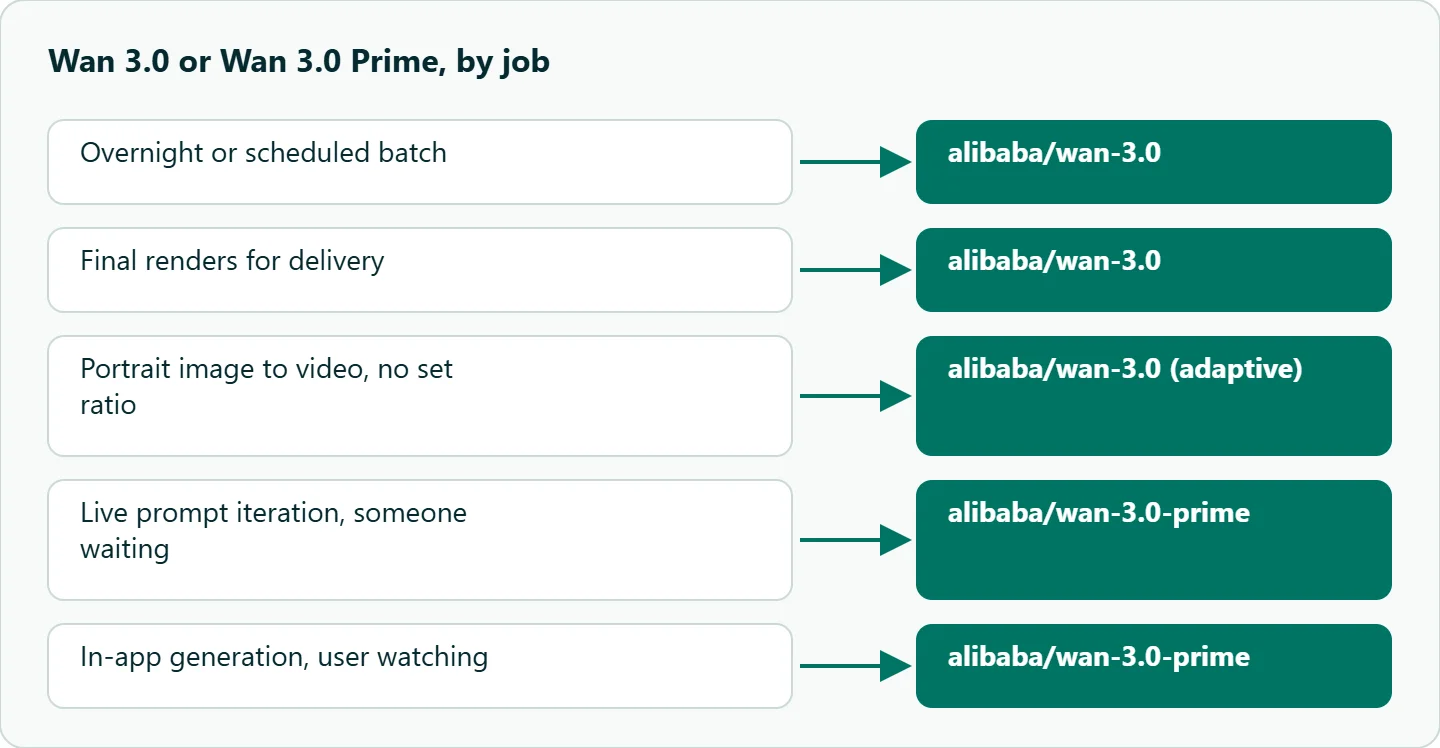
| Your job | Use | Why |
|---|---|---|
| Overnight or scheduled batch | alibaba/wan-3.0 |
No one is waiting; lower per-second rate |
| Final renders for delivery | alibaba/wan-3.0 |
No documented quality gain from Prime |
| Portrait image-to-video without a set ratio | alibaba/wan-3.0 |
adaptive follows the image |
| Live prompt iteration in a review session | alibaba/wan-3.0-prime |
Faster takes, if your tests confirm it |
| In-app generation with a user watching | alibaba/wan-3.0-prime |
Turnaround is the product |
| 2 to 3 second inserts | Either | Both accept 2 seconds; choose on speed versus spend |
If you are weighing Wan against a different family rather than within it, our Seedance 2.5 vs Wan 3.0 Prime comparison covers reference packs, edit and extend modes, and billing format across the two.
How to test this on your workload
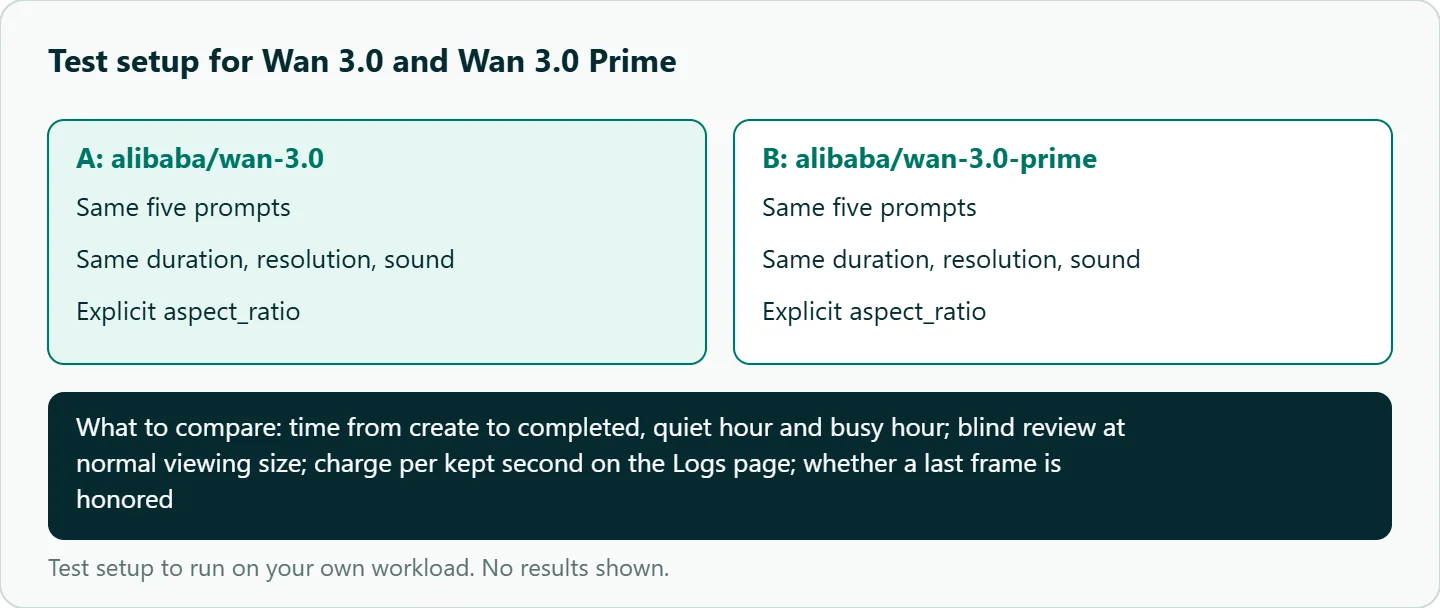
We have not run a speed or quality comparison for this article. This test answers the only question that separates the two models, which is whether Prime's speed is worth its rate for your jobs:
- Pick five prompts from real work: one text-to-video, two image-to-video with landscape frames, one with a portrait frame, and one 2-second insert.
- Send each to
alibaba/wan-3.0andalibaba/wan-3.0-primewith the same duration, resolution, sound setting and an explicitaspect_ratio. - Record the time from create to
completedfor each job, using the job'screated_atandcompleted_at. - Repeat the run at your busiest hour, since Prime can fall back to standard speed under load.
- Compare the clips blind at normal viewing size: can a reviewer tell which model made which?
- Check each job's charge on the console's Logs page and work out cost per finished second you would actually keep, and compare the charge on your slowest Prime jobs with the fast ones.
- Send one first-and-last-frame request to each model and confirm whether the clip lands on the last frame.
If reviewers cannot tell the clips apart and the turnaround gap does not change what your users experience, you have your answer: Wan 3.0.
Our take: Default to alibaba/wan-3.0. It lists the same fields as Prime plus adaptive, carries the lower per-second rate, and no source claims Prime looks better. Move a job to alibaba/wan-3.0-prime only when someone is waiting on the result, and only after your own timing shows the gap is real at the hours that matter.
Running it on OceanToken
Both Wan models answer on https://api.oceantoken.ai/v1/videos with the same OpenAI-compatible key and prepaid balance you use for text and image models, so an A/B between them is the same request with a different model value. A failed video job is not charged and its hold is released, the x-oceantoken-dropped-params header tells you when a field like adaptive could not be applied, and the model-spec endpoint lists each model's options before you spend anything. See the current per-second rates for both on /wan-api, or on the Wan 3.0 and Wan 3.0 Prime model pages.
FAQ
Is Wan 3.0 Prime better quality than Wan 3.0? No source we found says so. Alibaba describes them as one all-in-one model, and the Prime model page calls it a fast-mode variant.
What is the difference between Wan 3.0 and Wan 3.0 Prime in the API? The listed fields are the same except adaptive, which only Wan 3.0 offers. Prime is described as faster and has a higher per-second rate.
Can I switch from Wan 3.0 to Prime by changing only the model id? Yes, as long as you are not relying on adaptive. If you are, add an explicit aspect_ratio first.
Does Wan 3.0 Prime support a last frame? Its API reference lists first and last frames, but its model page mentions only the first frame. Check flf2v in the model-spec response and test one request before depending on it.
How are Wan 3.0 and Wan 3.0 Prime billed? Per second of video, with a rate for each resolution; Prime's rate is higher. See /wan-api for current rates.
Sources
- OceanToken docs: Wan 3.0 API reference (checked 2026-11-20)
- OceanToken docs: Wan 3.0 Prime API reference (checked 2026-11-20)
- OceanToken docs: Video guide (checked 2026-11-20)
- OceanToken: Wan 3.0 Prime model page (checked 2026-11-20)
- OceanToken: Wan 3.0 model page (checked 2026-11-20)
- Alibaba Cloud Model Studio: wan3.0-video-prime (checked 2026-11-20)
- Alibaba Cloud Model Studio: wan3.0-video (checked 2026-11-20)
- Alibaba Cloud Model Studio: Wan3.0 video generation guide (checked 2026-11-20)
Get your OceanToken API key
- Create an OceanToken account and an API key.
- Copy the snippet below, paste your key, and run it.
- Check the current rate on /wan-api.
curl https://api.oceantoken.ai/v1/videos \
  -H "Authorization: Bearer $OCEANTOKEN_API_KEY" \
  -H "Content-Type: application/json" \
  -d '{"model": "alibaba/wan-3.0", "prompt": "A paper boat drifting down a rain-soaked street", "duration": 5, "resolution": "480p"}'
More from the blog
Qwen3.8 Max vs GLM 5.3 vs DeepSeek V4 Pro
Qwen3.8 Max vs GLM 5.3 vs DeepSeek V4 Pro by job: coding agents, tool calling and JSON, long context, and how each handles thinking and reasoning_content.
Wan 3.0 Prime vs Veo 3.1: Image to Video
Wan 3.0 Prime vs Veo 3.1 image to video on one API: first and last frame fields, reference image limits, lengths, shapes and which model fits each shot type.
GTE-Large vs BGE-M3 for Multilingual RAG
GTE-Large vs BGE-M3 for RAG: English-only and 512 tokens vs 100+ languages and 8K input, what /v1/embeddings returns, and how chunking changes.