

Should You Switch From GPT to Qwen? A Workload Guide
Switch from GPT or Claude to Qwen? Official list prices side by side, a 10M-request cost example, and which workloads to move to Qwen first or keep.
By OceanToken Team
Editor's note: We sell Qwen, so weigh our bias. Our view: do not switch from GPT to Qwen wholesale, and do not assume Qwen is the cheap option by default. Small Western models now cost about the same per token. The case for Qwen is at the flagship tier, where Qwen3.8-Max charges $6 per million output tokens against $10 for Sonnet 5.5 and GPT-6.1 Sol, so the saving grows with how much your workload writes.
Short answer: Switch from GPT to Qwen, or from Claude, first where a flagship-tier model drives your bill: bulk extraction, summarization and translation. At list prices and 1,000 input to 200 output tokens, Qwen3.8-Max costs less than Sonnet 5.5 or GPT-6.1 Sol. Qwen3.8-Flash costs slightly more than Haiku 5.5 or GPT-6 Luna, so keep small-tier work.
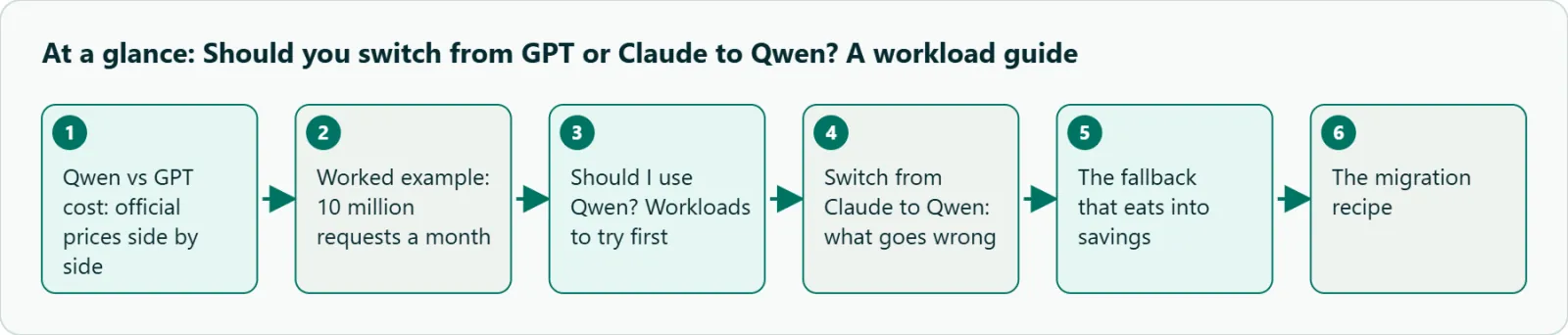
Qwen vs GPT cost: official prices side by side
Per 1M tokens, standard tier, no caching or batch discounts. Checked 2026-11-02.
| Model | Input | Output | Source |
|---|---|---|---|
| Qwen3.8-Flash | $0.15 | $0.47 | Alibaba (Singapore) |
| Qwen3.8-Max | $2.00 | $6.00 | Alibaba (Singapore) |
| Claude Haiku 5.5 (prompts up to 100K) | $0.10 | $0.50 | Anthropic |
| Claude Sonnet 5.5 | $2.00 | $10.00 | Anthropic |
| GPT-6 Luna | $0.10 | $0.50 | OpenAI |
| GPT-6.1 Sol | $2.00 | $10.00 | OpenAI |
Pairing models by tier is our judgment, not a vendor claim. Haiku 5.5 prompts over 100K tokens bill at higher rates.
Worked example: 10 million requests a month
Assume 1,000 input and 200 output tokens per request. That is 10,000M input and 2,000M output tokens.
| Model | Arithmetic | Monthly |
|---|---|---|
| Qwen3.8-Flash | 10,000 x $0.15 + 2,000 x $0.47 | $2,440 |
| Claude Haiku 5.5 or GPT-6 Luna | 10,000 x $0.10 + 2,000 x $0.50 | $2,000 |
| Qwen3.8-Max | 10,000 x $2 + 2,000 x $6 | $32,000 |
| Claude Sonnet 5.5 or GPT-6.1 Sol | 10,000 x $2 + 2,000 x $10 | $40,000 |
Flash does not beat the small Western tier on this mix. Its input costs $0.05 more per million, and with 10,000M input tokens that adds $500, while its cheaper output only saves $60. Max saves $8,000 a month against the flagship tier, and all of that comes from output. Input is $2 per million on all three flagship models, so the gap is the $6 against $10 output price on 2,000M tokens. That is also why the size of the saving belongs to this mix only (see current prices on the Models page). A task that writes long answers from short prompts saves a bigger share, and a task that reads long documents to return a label saves less.
One trap: Alibaba turns thinking on by default for qwen3.8-max and qwen3.8-flash, and thinking tokens bill as output. Leave it on by accident and the price edge can disappear. Set enable_thinking explicitly.
Should I use Qwen? Workloads to try first
| Workload | Try Qwen? | Why | How to check |
|---|---|---|---|
| Bulk extraction to JSON | Yes, first | A schema validator catches errors | Pass rate |
| Summarization at flagship tier | Yes | Max costs less on the example mix | Blind review |
| Chinese-English translation | Yes | Flagship price gap applies; quality depends on your language pair | Native-speaker review |
| Need to self-host | Yes | Some open sizes are Apache-2.0 | Hardware test |
| Coding assist and agents | Maybe | Vendor-reported: 73.4 on SWE-bench Verified for the open Qwen3.6-35B-A3B | Your repo's tests |
| Small-model classification | Neutral | Price is about even | Labeled set |
| High-stakes advice | Keep current | An error costs more than tokens | Expert review |
| Brand-voice writing | Keep current | Tuned prompts and taste | Blind A/B |
The table follows one idea: start where mistakes are cheap to catch. Bulk extraction comes first because a program can check every output. If Qwen's JSON fails your schema, the validator tells you on the first run, and you know the pass rate before any user sees a result. Summarization and translation get the same Max price gap, but their errors only show up in human review, so they take longer to judge. Translation is a yes for the price, with the quality question answered only by a native speaker reading your own language pair.
At the other end, high-stakes advice and brand-voice writing stay where they are. The cost of a wrong or off-tone answer there sits in the outcome, not in the tokens, so a smaller bill per request doesn't cover one bad answer that reaches a customer. Brand voice also depends on prompts your team has already tuned against one model, and that work doesn't carry over automatically.
Switch from Claude to Qwen: what goes wrong
The first trap to plan for is prompt portability. System prompt style, refusals and JSON habits differ between vendors, so a prompt tuned for Claude can produce output that is mostly right and still fails your validator, for example because of a different way of handling optional fields or extra text around the JSON. If you compare prices before you compare pass rates, you'll book a saving that the retries then take back. Run the validator on the new model first, and only then look at cost. Tool calling needs the same treatment, since argument formats and parallel calls differ, so retest with your real tools rather than a toy example.
Compliance can change the math as well. The Qwen prices in this article are Alibaba's Singapore list prices. If your customer contracts require processing in a specific region or under a specific provider, the Qwen option you're allowed to use may not be the one priced here, so check where requests are processed before you count the savings. Two smaller items round this out: models trained in different places answer some topics differently, so test your own domain, and ids get retired, so pin one.
The fallback that eats into savings
A common plan is "cheap model first, flagship on failure." Use the same token mix. A Flash call costs about $0.000244. A Haiku or Luna call costs $0.0002. A Sonnet call costs $0.004.
Take 15% as an example failure rate. It is an assumption for illustration, not a measurement. If 15% of Flash requests fail validation and rerun on Sonnet, the blended cost is $0.000244 + 0.15 x $0.004 = $0.000844. That is about $8,440 per 10 million requests. It is far below Sonnet alone at $40,000. But it is more than four times a Haiku-only setup that passes validation, so the fallback doesn't erase the saving against the flagship tier. It does eat most of it against the small tier.
You can work out your own break-even from the same numbers. The cost per request is $0.000244 + p x $0.004, where p is the share of Flash calls that fail and go to Sonnet. A Max-only setup costs $0.0032 per request, so Flash plus fallback stays cheaper as long as p is below about 74%.
Against Haiku or Luna at $0.0002 there is no break-even on price alone, because Flash costs more before any fallback. With both on a Sonnet fallback, Flash only comes out ahead if it fails about 1.1 percentage points less often than Haiku does. The formula leaves out two real costs, the extra latency on every rerun and the work of keeping two prompts working, so treat the break-even as an upper bound.
The migration recipe
Move one task class at a time, in the order of the workload table. Extraction goes first, because the validator gives you a pass rate within a day. Summarization and translation come next, since they need human review and take longer to judge. High-stakes work comes last, if ever. Keep the fallback to your current model on for each class you move, and switch it off only after the pass rate holds.
The code change itself is small, which is why the order matters more than the code. With an OpenAI-compatible client, the switch is the model id plus one parameter. The enable_thinking flag is there because thinking is on by default for Qwen3.8 hybrids, and for a ten-token label you don't want to pay for reasoning.
from openai import OpenAI

client = OpenAI(base_url="https://api.oceantoken.ai/v1", api_key="YOUR_OCEANTOKEN_KEY")

def classify(text):
    r = client.chat.completions.create(
        model="qwen/qwen3.8-flash",  # was: a GPT or Claude id
        messages=[{"role": "user", "content": f"Label billing|bug|other: {text}"}],
        extra_body={"enable_thinking": False},
        max_tokens=10,
    )
    return r.choices[0].message.content.strip()
How to test this on your workload
- Log 200 to 500 real prompts from one task class, with your current outputs.
- Run them on Qwen3.8-Flash, Qwen3.8-Max and your current model, with thinking set explicitly.
- Score with programmatic checks plus a blind human sample.
- Compute cost per passing task from real token counts, not per token. A cheap model that fails often is not cheap.
- Check
usagefor reasoning tokens after you turn thinking off.
Our take: Do not switch from GPT to Qwen across the board. Move flagship-tier bulk work to Qwen3.8-Max first, where the list-price gap is real. Keep small-tier work where it is unless Qwen wins on accuracy. In practice, start with one task class, such as bulk extraction, on Max. Compare two weeks of pass rate and actual bill against your current model, and only then decide whether to move the next class.
Running it on OceanToken
Use base URL https://api.oceantoken.ai/v1 with qwen/qwen3.8-flash, or qwen/qwen3.8-max-0902 for the larger model (Qwen3.8 Max model page). The reason to use OceanToken here is the A/B: Qwen and other model families sit behind one key, so a test is a model id change. See the current rate on /qwen-api.
FAQ
Is Qwen as good as GPT or Claude? On some tasks yes, on others no. Run a blind eval on your prompts before moving anything important.
Will switching cut my bill? At the flagship tier, likely. At the smallest tier, list prices are about the same.
Can I keep my OpenAI client code? Mostly. Change the base URL, key and model id, then retest tool calls and structured output.
Why did my Qwen bill come in higher than expected? Thinking is on by default for Qwen3.8 hybrids, and thinking tokens bill as output.
Sources
- Alibaba Cloud Model Studio: model pricing (checked 2026-11-02)
- Anthropic: Claude pricing (checked 2026-11-02)
- OpenAI: API pricing (checked 2026-11-02)
- Alibaba Cloud Model Studio: deep thinking (checked 2026-11-02)
- Qwen3.6-35B-A3B model card (checked 2026-11-02)
- OceanToken Qwen API page (checked 2026-11-02)
Get your OceanToken API key
- Create an OceanToken account and an API key.
- Copy the snippet below, paste your key, and run it.
- Check the current rate on /qwen-api.
curl https://api.oceantoken.ai/v1/chat/completions \
  -H "Authorization: Bearer $OCEANTOKEN_API_KEY" \
  -H "Content-Type: application/json" \
  -d '{"model": "qwen/qwen3.8-flash", "messages": [{"role": "user", "content": "Hello"}]}'
More from the blog
Seedance 2.5 vs Wan 3.0 Prime by Job
Seedance 2.5 vs Wan 3.0 Prime for API video: what each call can hold, how each is billed, and which jobs to send to which model, with ids and code.
Seedance vs Veo 3.1 for 1080p, by Shot
Seedance vs Veo 3.1 for 1080p: when Seedance 2.0 Upscaled is enough, when to render native on Seedance 2.5 or Veo 3.1, and the model ids for each shot.
Official Kling API vs a Multi-Model Gateway
Official Kling API or a multi-model gateway? Kling versions, keys, concurrency and result links compared, plus a simple rule for which route fits your product.