

Seedance API Access: ByteDance Official vs a Gateway
Seedance API access compared: ByteDance's official route vs a multi-model gateway, plus the resolution, duration, retry and billing settings to check first.
By OceanToken Team
Editor's note: In March, Caixin reported that ByteDance suspended the global rollout of Seedance 2.0 amid a copyright dispute, while the model stayed popular in China. Access to one model can shift fast and differ by region. We sell Seedance access, so weigh our view: the limits you get matter more than the route's name. If Seedance is one of several models, use one gateway key. Go direct only for a ByteDance contract.
Short answer: For Seedance API access you have two kinds of route: ByteDance's official API, or a multi-model gateway that serves Seedance next to other models. Go official if you need a direct ByteDance contract. Choose a gateway if Seedance shares a product with other models. Either way, compare resolution, duration, retry handling and billing before you commit.
The two routes to Seedance API access
ByteDance publishes Seedance and runs its own API for it. A DataCamp tutorial walks through that official route for Seedance 2.0 using the model id dreamina-seedance-2-0-260128 and ByteDance's Python SDK. We could not read ByteDance's own API docs directly (the pages render in the browser only), so the official column below relies on that tutorial. Treat it as reported, not official.
A gateway sits one step further out. It holds the upstream access and gives you one key and one API shape for many models. On our side, that means an OpenAI-style base URL and Seedance ids that sit next to Kling, DeepSeek and Qwen. Third-party hosts also resell Seedance, each with its own schema and limits, and those differ often enough that you should read each host's schema yourself rather than trust a summary.
Seedance official API vs a gateway, side by side
Values as published on November 2, 2026. They change often.
| ByteDance official API (per DataCamp) | OceanToken gateway | |
|---|---|---|
| Seedance versions | 2.0 | 2.0 and 2.5, each Native and Upscaled |
| Model id | dreamina-seedance-2-0-260128 |
bytedance/seedance-2.0, -2.0-upscaled, -2.5, -2.5-upscaled |
| Resolution | 480p to 4K | Upscaled: 720p, 1080p; 2.5 Native: 480p, 720p; 4K through sales |
| Duration | 4 to 15 s | Upscaled: 4 to 15 s; 2.5 Native: up to 30 s |
| Async style | Task create, then get | Create, poll, download |
The official route lists 4K self-serve for 2.0. On our side, 4K is not self-serve and goes through sales, per the /seedance-api page. If one-call 4K is a hard requirement today, that row decides it.
Settings to check on any Seedance route
Resolution and duration. Read the schema, not the headline. Ask each route for the exact values you plan to ship, then run ffprobe on a real output file to confirm the pixel size and length. Two routes are only comparable at matching settings.
Native or post-processed. Find out whether the file you get is ByteDance's render as delivered or a processed version of it. On our API that choice is explicit: Native ids call ByteDance's official API, one request per official task, and Upscaled ids add our own super-resolution on top of the official render (Upscaled vs Native).
Regional access. As the Caixin report shows, availability can change by region. Confirm the route works from where your users and servers are.
Billing on failure. Ask what happens when a render fails. The /seedance-api page says failed generations are not charged on our API: the cost is held while a clip renders and released if it fails.
Retries can double your bill
Video jobs are slow, so timeouts on the create call are common. If your client retries a create automatically, the route may start a second billed job for the same clip. Retry polling calls freely, but never let a library retry the create on its own.
Our gateway handles this with an Idempotency-Key header on create, per its video guide . A retried create with the same key does not start a second job. Whichever route you use, test how it handles a duplicate submit before you ship. Retries and rerolls are where most AI video budgets go; see why retries drive AI video ad costs.
How to choose a Seedance route
- Need a contract with ByteDance itself? Use ByteDance's official API.
- Need 4K from one self-serve call? The official route lists it for 2.0; on our side, talk to sales.
- Need clips up to 30 seconds? Use Seedance 2.5 Native.
- Using Seedance alongside Kling, LLMs or image models? Use one gateway key.
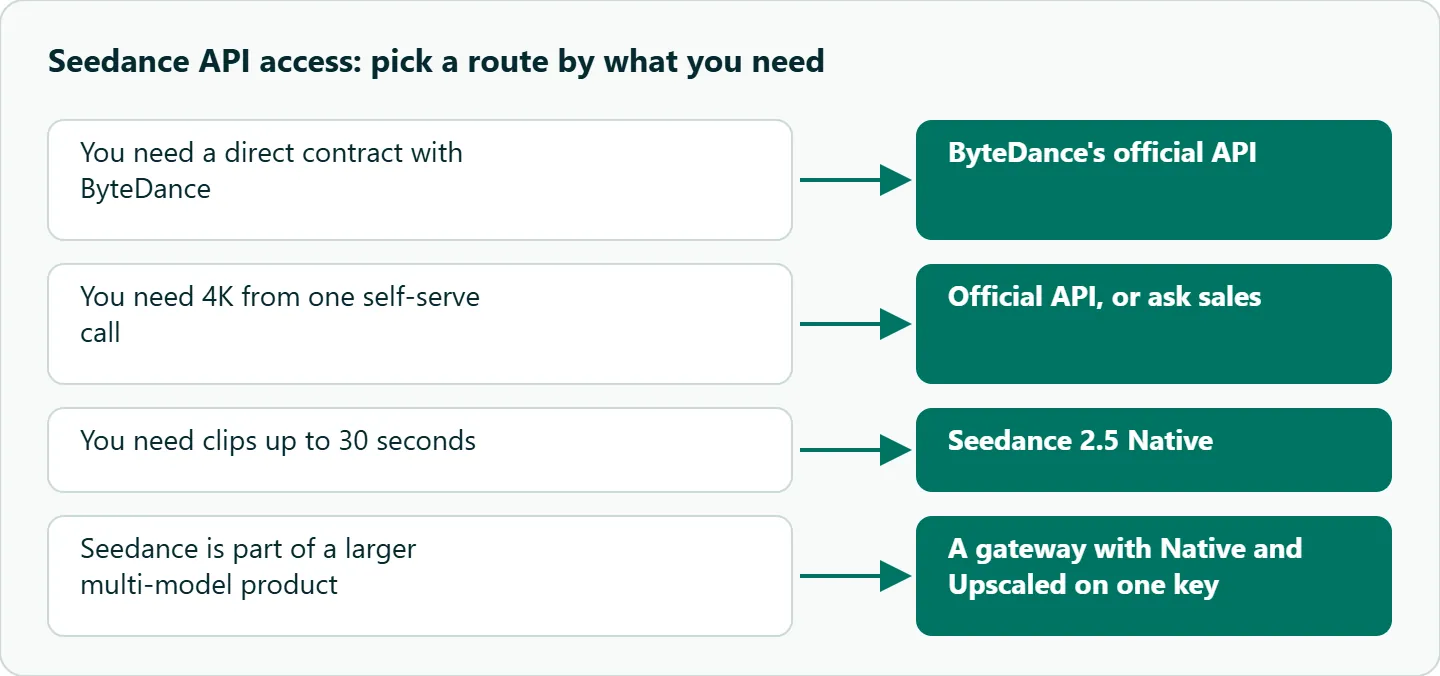
Our take: Default to a gateway when Seedance is part of a larger product. You get Native and Upscaled on the same key, which makes the quality call a one-line change, and your other models share the same integration. Go to ByteDance's official API when you need a direct contract or self-serve 4K today.
How to test this on your workload
- Pick three of your real prompts, including one with people or hands.
- Run each at 720p and 5 seconds on both routes with the same settings.
- Record time to completion, output pixel size and any refusals.
- Kill the network during one create call and see whether a retry makes a second job.
- Repeat once a week for a month before you lock in.
Running it on OceanToken
Point your client at https://api.oceantoken.ai/v1 and use bytedance/seedance-2.0-upscaled, bytedance/seedance-2.0, bytedance/seedance-2.5 or bytedance/seedance-2.5-upscaled. It is an OpenAI-style API, so moving an existing client over means changing the base URL and key. One key covers Seedance, Kling and text models, and switching between Native and Upscaled is a change to the model id. For parameter details per id, see our Seedance API parameters guide. See the current rate on /seedance-api.
FAQ
Is ByteDance's official Seedance API better than a gateway? It is the direct route and the one to use if you need ByteDance's own terms. A gateway is the better fit when Seedance is one of several models in your product.
Which route lists the highest Seedance resolution? ByteDance's official route lists Seedance 2.0 up to 4K, per DataCamp. On our API, 4K goes through sales.
Do all routes accept the same parameters? No. Names, limits and reference caps differ by route and version, so check each schema.
Can I move between routes later? Yes, if you keep prompts and settings as data and map parameter names in one adapter.
Sources
- DataCamp: Seedance 2.0 API guide (checked 2026-11-02)
- OceanToken Seedance API page (checked 2026-11-02)
- OceanToken video guide (checked 2026-11-02)
- OceanToken: Seedance 2.0 Upscaled vs Native (checked 2026-11-02)
- Caixin Global: ByteDance halts global rollout of Seedance 2.0 amid copyright dispute (checked 2026-11-02)
Get your OceanToken API key
- Create an OceanToken account and an API key.
- Copy the snippet below, paste your key, and run it.
- Check the current rate on /seedance-api.
curl https://api.oceantoken.ai/v1/videos \
  -H "Authorization: Bearer $OCEANTOKEN_API_KEY" \
  -H "Content-Type: application/json" \
  -d '{"model": "bytedance/seedance-2.0-upscaled", "resolution": "720p", "duration": 5, "prompt": "Aerial shot over a harbor at dawn"}'
More from the blog
Seedance 2.5 vs Wan 3.0 Prime by Job
Seedance 2.5 vs Wan 3.0 Prime for API video: what each call can hold, how each is billed, and which jobs to send to which model, with ids and code.
Seedance vs Veo 3.1 for 1080p, by Shot
Seedance vs Veo 3.1 for 1080p: when Seedance 2.0 Upscaled is enough, when to render native on Seedance 2.5 or Veo 3.1, and the model ids for each shot.
Official Kling API vs a Multi-Model Gateway
Official Kling API or a multi-model gateway? Kling versions, keys, concurrency and result links compared, plus a simple rule for which route fits your product.