

Seedance 2.5 vs Wan 3.0 Prime by Job
Seedance 2.5 vs Wan 3.0 Prime for API video: what each call can hold, how each is billed, and which jobs to send to which model, with ids and code.
By OceanToken Team
Editor's note: Both models now run up to 30 seconds with sound, so the headline specs look like a tie. They are not. What separates them is what one call can hold, which controls the API exposes, and how the bill is counted. "Better value" only means something once you know which of your jobs each model can finish in one call.
Short answer: In Seedance 2.5 vs Wan 3.0 Prime, send multi-shot dialogue scenes, edits and extensions of existing clips, big reference packs, 21:9 frames and seeded A/B tests to Seedance 2.5. Send 2 to 3 second inserts and quick first-frame drafts to Wan 3.0 Prime. Seedance bills by video tokens, Wan by the second.
01 · What one call can hold
Quality is subjective and changes with every prompt. The request limits do not, and they decide which model can do a job at all. These come from each model's API reference, checked on November 13, 2026.
Seedance 2.5 (bytedance/seedance-2.5) |
Wan 3.0 Prime (alibaba/wan-3.0-prime) |
|
|---|---|---|
| Clip length | 4 to 30 s, default 5 | 2 to 30 s, default 5 |
| Resolution | 480p, 720p, 1080p | 480p, 720p, 1080p |
| Aspect ratio | 16:9, 4:3, 1:1, 3:4, 9:16, 21:9, adaptive | 16:9, 4:3, 1:1, 3:4, 9:16 |
| Sound | generate_audio |
generate_audio |
| First and last frame | Up to 2 frames | Up to 2 frames |
| Reference media | Up to 30 images, 10 videos, 10 audio | Up to 10 images listed |
| Edit or extend a clip | omni_reference_task_type: reference, edit, extend, auto |
No task-type parameter listed |
seed |
Yes | Not listed |
return_last_frame |
Yes | Not listed |
Three rows decide most routing. Seedance's reference allowance is three times larger for images and adds explicit edit and extend modes. Wan accepts clips as short as 2 seconds. And only Seedance lists seed, which you need if you want to change one word in a prompt and see what that word did.
02 · Seedance 2.5 vs Wan 3.0 Prime by job
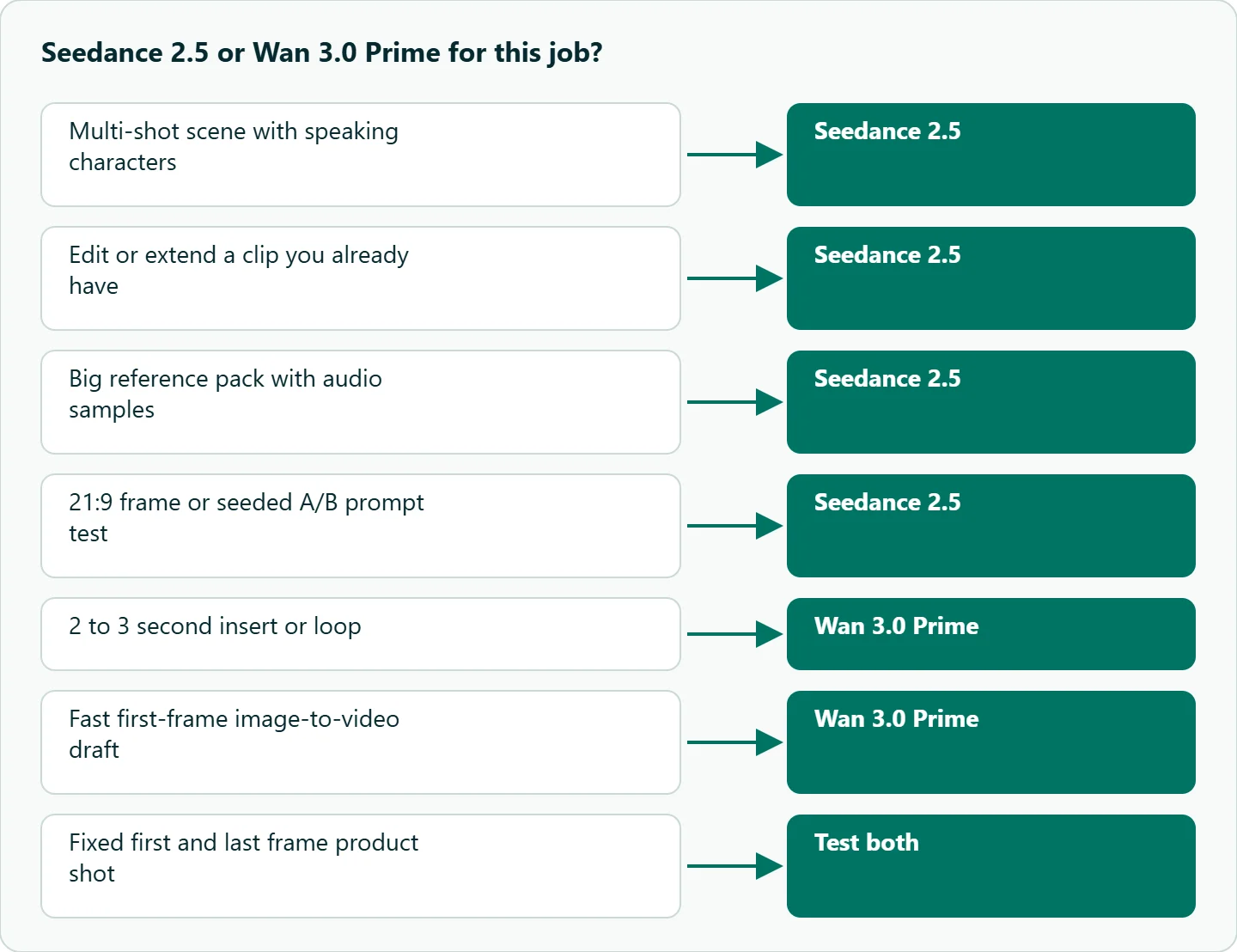
| Job | Start with | Why |
|---|---|---|
| Multi-shot scene with two or more speaking characters | Seedance 2.5 | ByteDance describes multi-shot story arcs and consistent voices per character |
| Edit or extend a clip you already have | Seedance 2.5 | edit and extend are explicit modes |
| Product ad built from many angles, a logo and a voice sample | Seedance 2.5 | Larger reference pack, with audio references |
| 21:9 cinematic frame | Seedance 2.5 | Wan 3.0 Prime does not list 21:9 |
| Prompt A/B test where only one word changes | Seedance 2.5 | Fixed seed keeps the rest similar |
| 2 to 3 second B-roll insert or loop | Wan 3.0 Prime | Accepts 2 s; Seedance starts at 4 s |
| Fast first-frame image-to-video drafts | Wan 3.0 Prime | Described as a fast-mode variant |
| Product shot with fixed first and last frame | Test both | Both API references list two frames; Wan's model page mentions only the first frame, so confirm first |
The table is where your first attempt should go, not a ranking. The next two sections explain the rows that are not obvious.
03 · Where Seedance 2.5 pulls ahead
ByteDance's Seedance 2.5 announcement centers on two things: one-take generation of up to 30 seconds that can organize several connected shots into a story, and flexible referencing with up to 30 images, 10 video clips and 10 audio clips in one pass. It also describes sound and picture generated together, with each character's voice kept consistent in multi-character scenes, and timestamp-level control for targeted edits.
The API exposes most of that directly. omni_reference_task_type lets you say whether references should build a new clip, edit a supplied video, or extend it, and the docs advise stating the same intent in the prompt. return_last_frame hands back the final frame as a JPEG, which is the cleanest way to chain a continuation into the next call. For a dialogue scene that has to hold together for 20 seconds, those controls matter more than any single frame's look.
Where this advantage fades: if your job is a single 5-second shot from a text prompt, none of those controls are in play, and the choice comes down to how each model renders your subject. Test that rather than assuming.
04 · Where Wan 3.0 Prime fits
The Wan 3.0 Prime model page describes it as a fast-mode variant of Wan 3.0 for text-to-video and first-frame image-to-video. Its API reference, though, lists frame_images with both a first and a last frame, so check GET https://api.oceantoken.ai/oceantoken/video/model-spec?model=alibaba/wan-3.0-prime before planning last-frame shots on Prime. Alibaba's own Wan3.0 guide lists the Prime name alongside the base model as one all-in-one model and does not spell out a difference, so treat "fast mode" as the reason to try it for drafts and confirm the speed on your own jobs.
Wan's shortest clip is 2 seconds, which is useful for inserts: a pour, a product turn, a logo resolve. It is billed per second of video, so a 2-second request should bill as a 2-second clip; check the charge on the console Logs page on your first run. Alibaba's Wan3.0 launch post also mentions multilingual voice output and clips of up to 30 seconds.
What Prime does not list on its API page matters as much. There is no seed, no task-type switch, and no 21:9. Alibaba documents editing and extension for the Wan3.0 family, but without a parameter for it here, we would route edits to Seedance 2.5 unless your own tests show Wan handling them from the prompt alone. For the full non-Prime model, see Wan 3.0.
05 · Billing format and what you get per call
"Value" here means two things you can check: how each call is counted, and how much finished video one call can produce. For the rates themselves, see /seedance-api and /wan-api.
| Seedance 2.5 | Wan 3.0 Prime | |
|---|---|---|
| Billing unit on the model page | Per 1M video tokens | Per second of video, by resolution |
| How the count grows | width × height × (24 × seconds + 1) ÷ 1024 | Seconds × the resolution's rate |
| Changes the count | Length, resolution, aspect ratio | Length, resolution |
| Shortest clip accepted | 4 s | 2 s |
| Longest single call | 30 s | 30 s |
The practical effect: on Seedance, frame shape is part of the bill because the token formula multiplies width by height. On Wan, the resolution tier and the seconds are the whole story. On both, drafting at 480p and short durations is the cheapest way to iterate, and the video guide says cost also depends on sound, the estimate is held while a job runs, and a failed job is not charged.
06 · How to call both
Both models use POST https://api.oceantoken.ai/v1/videos, so an A/B run is the same request with a different model:
import os, requests
BASE = "https://api.oceantoken.ai/v1"
H = {"Authorization": f"Bearer {os.environ['OCEANTOKEN_API_KEY']}"}
prompt = "A barista pours latte art in a sunlit cafe, slow push-in"

for model in ["bytedance/seedance-2.5", "alibaba/wan-3.0-prime"]:
    job = requests.post(f"{BASE}/videos", headers={**H, "Idempotency-Key": f"latte-{model}"},
        json={"model": model, "prompt": prompt, "duration": 5,
              "resolution": "480p", "aspect_ratio": "16:9", "generate_audio": False}, timeout=60)
    job.raise_for_status()
    print(model, job.json()["id"])  # poll GET /videos/{id}, then download /content
Poll each id every 10 to 20 seconds until status is completed, then download from /v1/videos/{id}/content within 24 hours. The Seedance quickstart has the full polling loop, and the Wan ads pipeline guide shows Wan inside a production workflow.
| Parameter | Seedance 2.5 | Wan 3.0 Prime | Note |
|---|---|---|---|
duration |
4 to 30 | 2 to 30 | seconds also accepted |
aspect_ratio |
adds 21:9, adaptive |
5 fixed ratios | |
seed |
Yes | Not listed | Dropped if not accepted |
omni_reference_task_type |
Yes | Not listed | Dropped if not accepted |
A field a model does not take is removed before the request reaches it and named in the x-oceantoken-dropped-params header. Log that header in A/B scripts so a silently dropped seed does not skew your comparison.
How to test this on your workload
We have not run these prompts for this article. A fair comparison changes only the model:
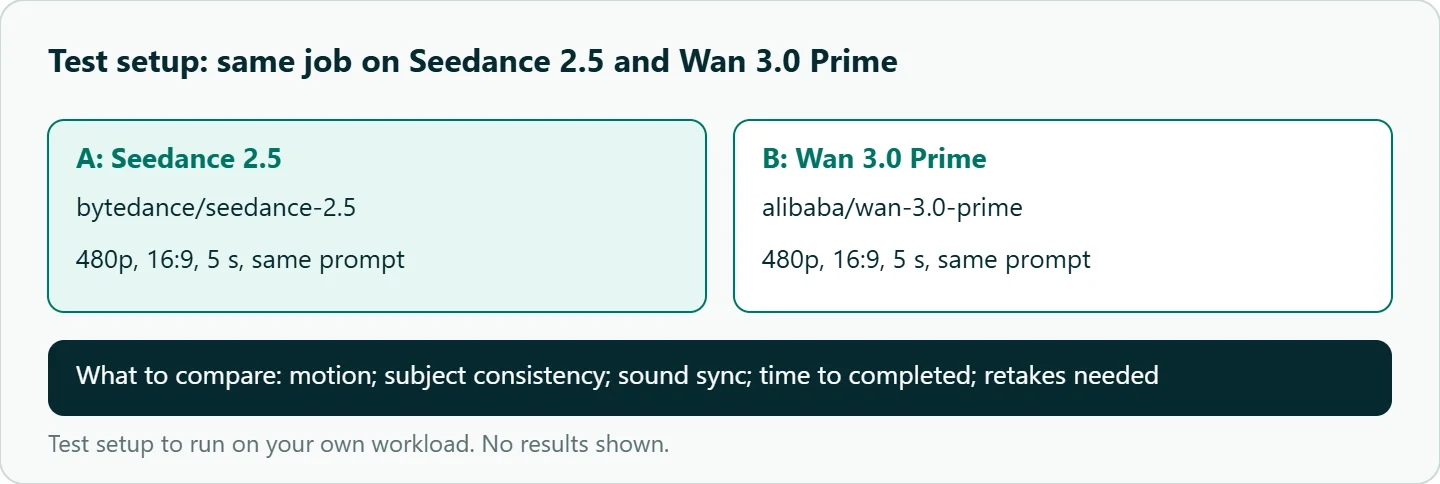
- Pick three jobs from your queue: a dialogue scene, a product shot with a first frame, and a short insert.
- Use identical prompt text, 480p, 16:9 and the same duration on both (5 s covers both minimums).
- Run each three times; judge the middle result.
- Record time from create to
completedand the charge shown on the console's Logs page for each job. - Score blind: motion, subject consistency, sound sync, and how many retakes you would need.
Our take: Make Seedance 2.5 your default for anything with a story, a voice, a reference board or an existing clip to change, because those jobs depend on controls only Seedance exposes here. Use Wan 3.0 Prime for short inserts and fast first-frame drafts, where its 2-second floor and per-second billing fit the job. If both can do a job, pick the one that needs fewer retakes in your test, not the one with the lower sticker rate.
Running it on OceanToken
Both models run on OceanToken with one key against https://api.oceantoken.ai/v1, so splitting jobs between bytedance/seedance-2.5 and alibaba/wan-3.0-prime is a one-field change in the same script. The API is OpenAI-compatible, you pay per use from one prepaid balance with no subscription, and failed video jobs are not charged. See the current rates on /seedance-api and /wan-api, and the Seedance 2.5 model page for the full parameter list.
FAQ
Is Seedance 2.5 or Wan 3.0 Prime better? Neither across the board. Seedance 2.5 has more controls (edit, extend, seed, bigger reference packs); Wan 3.0 Prime suits short inserts and fast drafts.
How long can each clip be? Both go up to 30 seconds per call. Wan 3.0 Prime starts at 2 seconds, Seedance 2.5 at 4.
How are they billed? Seedance 2.5 per 1M video tokens, which scales with frame size and length; Wan 3.0 Prime per second by resolution. Rates are on /seedance-api and /wan-api.
Can Wan 3.0 Prime edit an existing video? Its API page lists no edit or extend parameter, so use Seedance 2.5 for edits unless your tests show otherwise.
What is the difference between Wan 3.0 and Wan 3.0 Prime? The model page describes Prime as a fast-mode variant of Wan 3.0; Alibaba lists both names as one model family without detailing a difference.
Sources
- OceanToken docs: bytedance/seedance-2.5 (checked 2026-11-13)
- OceanToken docs: alibaba/wan-3.0-prime (checked 2026-11-13)
- OceanToken docs: Video guide (checked 2026-11-13)
- OceanToken: Seedance 2.5 model page (checked 2026-11-13)
- OceanToken: Wan 3.0 Prime model page (checked 2026-11-13)
- ByteDance Seed: Introducing Seedance 2.5 (checked 2026-11-13)
- Alibaba: Wan3.0 launch announcement (checked 2026-11-13)
- Alibaba Cloud: Wan3.0 video generation guide (checked 2026-11-13)
Get your OceanToken API key
- Create an OceanToken account and an API key.
- Copy the snippet below, paste your key, and run it.
- Check the current rate on /seedance-api.
curl https://api.oceantoken.ai/v1/videos \
  -H "Authorization: Bearer $OCEANTOKEN_API_KEY" \
  -H "Content-Type: application/json" \
  -d '{"model": "bytedance/seedance-2.5", "prompt": "A barista pours latte art in a sunlit cafe, slow push-in", "duration": 5, "resolution": "480p", "aspect_ratio": "16:9"}'
More from the blog
Seedance vs Veo 3.1 for 1080p, by Shot
Seedance vs Veo 3.1 for 1080p: when Seedance 2.0 Upscaled is enough, when to render native on Seedance 2.5 or Veo 3.1, and the model ids for each shot.
Official Kling API vs a Multi-Model Gateway
Official Kling API or a multi-model gateway? Kling versions, keys, concurrency and result links compared, plus a simple rule for which route fits your product.
Qwen API: Alibaba Direct vs a Gateway
Qwen API from Alibaba Model Studio direct vs an OpenAI-compatible gateway: regional keys and endpoints, workspaces, default thinking and enable_thinking.