

Gemini 1M Context Window vs RAG: When to Paste It All
Gemini 1M context window vs RAG: a token rule for when to paste the whole corpus, when to retrieve, and how caching and Gemini 4's shared window change it.
By OceanToken Team
Editor's note: "Long context kills RAG" is half right. The right half: one contract or repo that fits in the window is simpler to paste, and the model sees links between distant sections that a retriever can miss. The wrong half: paste a corpus you query all day and you pay for the whole corpus on every question. Our rule below uses numbers, but they are starting points to replace with your own results.
Short answer: In the Gemini 1M context window vs RAG choice, paste everything when the corpus is under about 600K tokens, you ask a few dozen questions about it, and answers need to connect distant sections. Use RAG when the corpus is bigger, changes often, or serves heavy query volume. Context caching moves the line toward pasting.
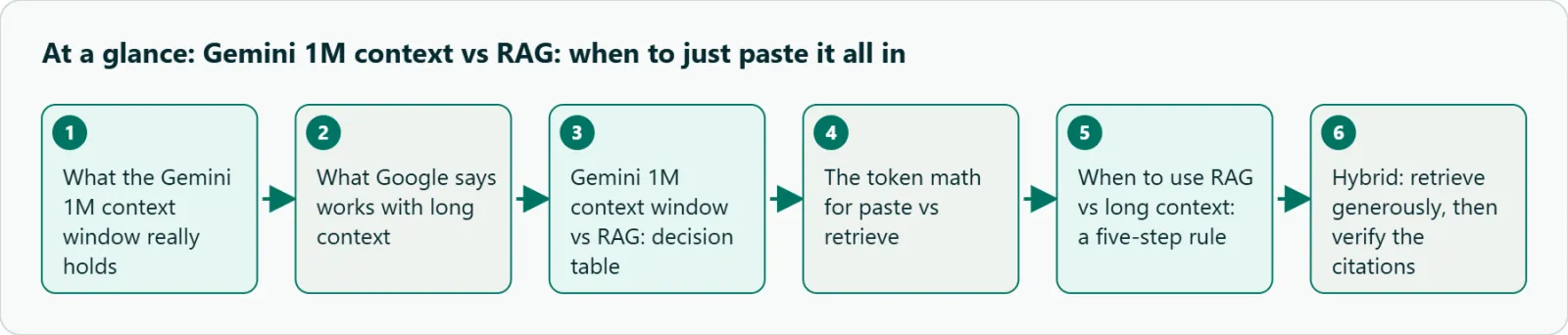
What the Gemini 1M context window really holds
Google's long-context guide draws a line between model generations:
- Gemini 4 (
gemini-4-argon): one 1M-token window shared by input, thinking and output. If input plusmax_output_tokensgoes over 1,048,576, the API caps output to the space left. - Gemini 3 and 2.5 models: a separate 1M input budget and a 64K output budget.
On Gemini 4, a 950K-token prompt leaves almost no room to think or answer, and the API will cap the output to whatever space is left. That is the reason the rule further down tells you to leave headroom on Gemini 4. On gemini-3.8-flash, the output budget does not shrink as the prompt grows, so a near-full prompt still gets its full 64K to answer.
For scale, Google says 1M tokens is about 50,000 lines of code at 80 characters a line, or 8 average-length English novels. That makes the 600K threshold used below easier to picture: about 30,000 lines of code, or five novels' worth of text.
What Google says works with long context
Three points from Google's guide shape the decision. The first is about recall. Finding one fact in a huge input works well, but when you ask for many facts at once, the guide says accuracy drops, and it can vary widely by context. That rules out the most tempting use of a big window, pasting a whole contract and asking for "every clause that mentions termination," as a single call.
The second point is a writing rule for the paste route: results are usually better when the query comes after all the other material, so put the question last. The third is cost. Context caching cuts the cost of asking many questions about the same material, with storage billed per hour, and it decides whether pasting can survive more than a handful of questions.
Gemini 1M context window vs RAG: decision table
| Situation | Better choice | Why |
|---|---|---|
| One contract, report or repo under ~600K tokens; up to ~50 questions | Paste it all | No chunking bugs; cross-references stay intact |
| Support knowledge base, thousands of queries a day | RAG | Each query sends a few thousand tokens, not the whole base |
| Corpus well over 1M tokens | RAG or hybrid | It does not fit |
| Same large document, many questions within an hour | Paste plus caching | Pay full rate once, cached rate after |
| "Find every clause that..." | Chunked passes, then verify | Multi-needle recall drops |
| Data changes every few minutes | RAG | A cache goes stale too fast |
The token math for paste vs retrieve
Take a 400,000-token contract bundle and 100 analyst questions of about 150 tokens each.
- Paste every time: 100 x 400,150 = about 40M input tokens.
- Retrieve 40 chunks of 800 tokens: 100 x 32,150 = about 3.2M input tokens.
That is a 12.5x gap in raw input. Caching narrows it. Google's pricing page (checked 2026-11-02) lists cached input on gemini-3.8-flash at one tenth of the standard input rate, plus an hourly storage fee. Work it through: the first question pays for the full 400K bundle, and each of the other 99 reads the bundle at one tenth, so 99 x 400,000 x 0.1 is about 4M tokens' worth. Add the first full read and the paste route comes to roughly 4.4M equivalent input tokens plus storage, against 3.2M for retrieval. The 12.5x gap shrinks to about 1.4x.
That is the real point of this section. With caching, pasting is close to retrieval on cost, as long as you ask your questions while the cache is alive. Spread the same 100 questions over a week and the hourly storage fee, or a cache you have to rebuild, takes that advantage away.
Two dates to watch on that page. The listed gemini-3.8-flash rates run through December 31, 2026, and the page shows them doubling from January 1, 2027. And gemini-4-argon lists implicit caching only, so you cannot pin a cache yourself on it.
Multiply these token counts by the current rate for your route. For OceanToken, see /gemini-api.
When to use RAG vs long context: a five-step rule
- Count corpus tokens. Over about 600K, plan on retrieval. On Gemini 4, leave room for thinking and output too.
- Count questions per corpus per hour. Under about 50, paste. Above that, price the cached route first.
- Sort the question mix. Single-fact lookups favor RAG. Cross-section questions favor pasting. Exhaustive lists need chunked passes either way.
- Check how often the data changes. If it changes faster than your cache lifetime, retrieve.
- Build 20 test questions with known answers. Run both routes and compare cost per correct answer.
Neither threshold comes from Google, so here is where they come from. The 600K line is headroom. It leaves about 400K of the 1M window free, which covers thinking and output on Gemini 4 and leaves a margin for the many-needle recall drop Google describes. The 50-question line is weaker. It is a starting assumption, not a break-even we can derive. Without caching, pasting costs about 12.5 times retrieval per question at any volume, so the gap never closes. What grows with volume is the size of the bill. Above roughly 50 questions, run the cached-route math from the previous section with your own counts, and let step 5 settle it.
Hybrid: retrieve generously, then verify the citations
A long window changes how you should tune retrieval. You no longer need a retriever that returns exactly the right three chunks.
- Retrieve 20 to 50 chunks instead of 5.
- Pass each chunk with its source id and ask for citations.
- Put the question at the end.
- For high-stakes answers, run a second pass that checks each quoted line exists in the source.
This can look like a contradiction. Handing the model 30 to 50 chunks and asking it to pick out what matters is exactly the many-needle situation where Google says recall drops. The hybrid works anyway because it doesn't rely on the model's recall alone. The source ids make every claim traceable to a chunk, and the second pass checks that each quoted line actually exists. A wrong or missing citation becomes something you can detect, where in a plain paste it would pass silently. Generous retrieval protects you from the retriever missing a chunk, and the citation check protects you from the model missing or inventing one.
Our take: Treat the 1M window as room to be generous with retrieval, not as a reason to delete it. Save full-document pasting for jobs where the links between sections are the point: due diligence, legal review and large code changes. For everything queried at volume, keep RAG and feed the model more chunks.
Failure cases on each side
| Approach | Typical failure | Fix |
|---|---|---|
| Paste everything | Misses a middle section; lists drop entries | Question last; quotes with locations, checked as in the hybrid section |
| Paste everything | Long wait on every call | Cache, stream, or precompute summaries |
| Paste on Gemini 4 | Output cut short near the limit | Stay well under 1M; leave room for thinking |
| RAG | Relevant chunk never retrieved | Retrieve generously (see hybrid); add keyword search |
| RAG | Chunk cuts a clause in half | Overlap chunks; split by heading |
| RAG | Stale index after edits | Re-index on change; version each chunk id |
These failures don't cost the same, mostly because some of them announce themselves and some don't. A long wait on every call shows up in your latency graphs on day one, and so does truncated output on Gemini 4. A missed middle section, a dropped list entry or a chunk the retriever never returned fails silently: the answer reads as complete and nobody knows what is missing. That silent group is the expensive one, and it exists on both sides. So whichever route you pick, budget for the verification step in the hybrid section rather than only for speed.
How to test this on your workload
- Take one document of about 300K tokens.
- Write 10 questions: 5 single-fact, 5 that need two distant sections.
- Run each on
google/gemini-3.8-flashtwice: once with the whole document, once with 30 retrieved chunks. - Score correctness and record input tokens and time to first token.
- Repeat the pasted run with caching on and compare the token bill.
Running it on OceanToken
Use base URL https://api.oceantoken.ai/v1 with google/gemini-3.8-flash (Gemini 3.8 Flash model page) for the paste-and-ask route, or google/gemini-4-argon if you want Gemini 4. Our catalog lists a 1.05M-token window for both. The reason to use OceanToken here is that the cheap retrieval model and the long-context model can sit on one key and one balance. In practice that means a smaller, cheaper model from the catalog handles retrieval and reranking, and google/gemini-3.8-flash handles the final long-context step. Moving a workload between the paste route and the hybrid route is then a change of model id and prompt, not a second integration. See the current rate on /gemini-api.
FAQ
Is the Gemini 1M window input only? On Gemini 3 and 2.5 models, yes, with a separate 64K output budget. On Gemini 4, the window is shared by input, thinking and output.
Does long context stop hallucination? No. Recall drops when you ask for many items at once.
Should the question go first or last? Last, per Google's guide.
Is RAG dead? No. For high-volume or fast-changing data, retrieval is still cheaper and fresher.
What if my document is just over the limit? Split by chapter and summarize each, or retrieve. Do not let it truncate silently.
Sources
- Google: Long context (checked 2026-11-02)
- Google: Gemini API pricing (checked 2026-11-02)
- OceanToken Gemini API page (checked 2026-11-02)
Get your OceanToken API key
- Create an OceanToken account and an API key.
- Copy the snippet below, paste your key, and run it.
- Check the current rate on /gemini-api.
curl https://api.oceantoken.ai/v1/chat/completions \
  -H "Authorization: Bearer $OCEANTOKEN_API_KEY" \
  -H "Content-Type: application/json" \
  -d '{"model": "google/gemini-3.8-flash", "messages": [{"role": "user", "content": "Hello"}]}'
More from the blog
Seedance 2.5 vs Wan 3.0 Prime by Job
Seedance 2.5 vs Wan 3.0 Prime for API video: what each call can hold, how each is billed, and which jobs to send to which model, with ids and code.
Seedance vs Veo 3.1 for 1080p, by Shot
Seedance vs Veo 3.1 for 1080p: when Seedance 2.0 Upscaled is enough, when to render native on Seedance 2.5 or Veo 3.1, and the model ids for each shot.
Official Kling API vs a Multi-Model Gateway
Official Kling API or a multi-model gateway? Kling versions, keys, concurrency and result links compared, plus a simple rule for which route fits your product.