

Claude API: Anthropic Direct vs a Multi-Model Gateway
Claude API direct from Anthropic vs a multi-model gateway: which features you keep, request size, region control, spend caps and when one key wins.
By OceanToken Team
Editor's note: The same Claude models sit behind every door, so this is not a quality question. It is about which features you can count on, how big a request can be, and who sets your limits. Our default: if your product is Claude-only and leans on batch jobs or server tools, go direct to Anthropic. If Claude is one model among several, a gateway saves you a pile of keys and clients. We sell a gateway, so weigh that.
Short answer: For the Claude API, direct vs gateway comes down to features and how many models you call. Anthropic's own API gets every feature, including Message Batches, the Files API and server tools, plus a 128 MB request limit. A multi-model gateway gives you Claude and other families on one key, but test any advanced feature before you rely on it.
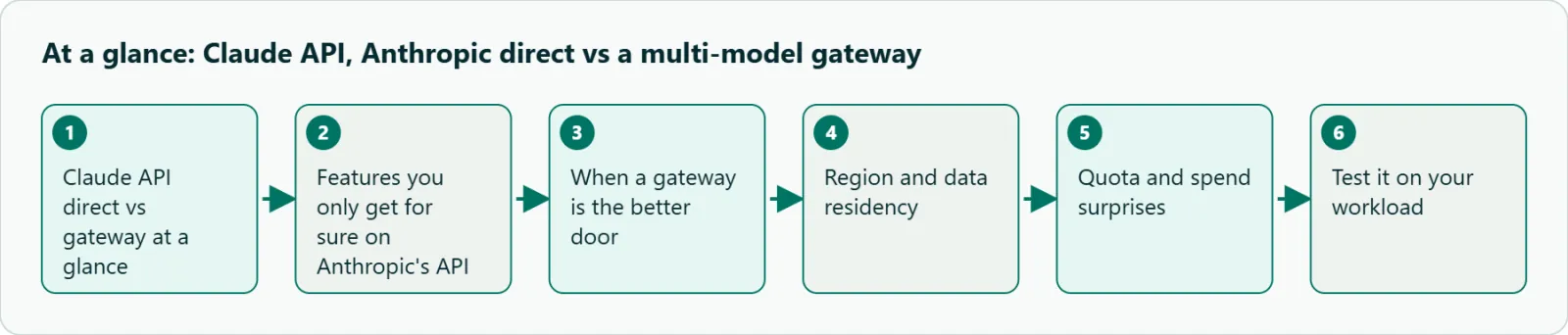
Claude API direct vs gateway at a glance
There are three ways most teams end up calling Claude: Anthropic's own API, a multi-model gateway such as OceanToken, or a third-party cloud host they already pay for. The Anthropic column comes from Anthropic's platform pages and the gateway column from our own pages, all checked 2026-11-02. Where a fact is not published, the table says so instead of guessing.
| Anthropic direct | Multi-model gateway (OceanToken) | Third-party cloud host | |
|---|---|---|---|
| Auth | Anthropic API key | One OceanToken key | Your cloud's identity system |
| Billing | Anthropic | Prepaid OceanToken balance | Your cloud bill |
| Model id example | claude-sonnet-5-5 |
anthropic/claude-sonnet-5.5 |
Host-specific |
| API shape | Anthropic Messages | OpenAI-compatible, plus /v1/messages |
Host-specific |
| Max request size | 128 MB (Messages) | Not published; test | Check the host's limits |
| Message Batches, Files API | Yes | Not stated; test one call | Not on every host |
| Server tools (web search, code execution, web fetch, advisor) | Yes | Not stated; test one call | Varies by host |
| Other model families on the same key | No | Yes | Varies by host |
| Region control | inference_geo (us or global) |
Not stated | Endpoint choice |
Features you only get for sure on Anthropic's API
New Claude features land on Anthropic's own API first, and that is the main reason to go direct. Three cases decide it for most teams.
Batch jobs. Anthropic offers a Message Batches API for bulk work that does not need an instant answer. If your plan is a nightly job over thousands of documents, you want the batch endpoint, and only the direct API documents it for certain.
Large documents. The Messages API accepts requests up to 128 MB. A 25 MB PDF fits. Other routes may cap payloads lower, so test a large-file workflow on the exact route you plan to ship on.
Server tools. Web search, code execution, web fetch and the advisor tool run on Anthropic's side. Any route that sits between you and Anthropic has to pass those through. If an agent depends on a server tool, confirm the tool actually ran by checking the response, not just that the call returned.
If you go through a third-party cloud host instead, find that host's list of unsupported features and read it before you design around one.
When a gateway is the better door
A gateway earns its place when Claude is not your only model. Say your product uses Claude for writing, a cheaper model for classification and a video model for clips. Going direct means three accounts, three keys, three billing setups and three client libraries. A gateway turns that into one key, one prepaid balance and one OpenAI-compatible client, and switching models becomes a change to the model id string.
The trade-off is that a gateway adds a layer, and a layer can drop things. Prompt caching, effort settings and server tools all depend on the gateway forwarding them as Anthropic expects. That is why we tell readers to send one test call for each advanced feature before building on it. A single call is cheap, and debugging an agent that quietly skips a tool is not.
A gateway also does not help if you are bound by a cloud contract. If procurement says every AI call must bill through a specific cloud, that decides the route before features do.
Region and data residency
On the direct API, Anthropic's data-residency page describes an inference_geo setting with us or global. If a customer contract says inference must stay in the US, that setting is the documented way to meet it on Anthropic's side.
A gateway or third-party host adds its own processing layer, so the residency question becomes two questions: where Anthropic runs inference, and where the middle layer handles your request. If residency is a hard requirement, settle it in writing before you pick a route. If it is not, region control is rarely the deciding factor.
Quota and spend surprises
- Direct spend caps. Anthropic's Start, Build and Scale tiers each carry a monthly spend cap. Hitting it returns a 429 with no
retry-afteranderror_code: enforced_spend_limit_reached. SDK retries keep failing until next month or a tier increase, so treat that error code as a stop signal, not a retry signal. - Self-set limits. A spend limit you set yourself on the direct API returns a 400
invalid_request_error, not a 429. Code that only handles 429 will log it as a bad request. - Gateway balance. On a prepaid gateway the limit is your balance, and on OceanToken each key can have its own spending limit. Give each service its own key so one runaway job cannot drain the rest.
- Cloud throttles. On a third-party cloud host, the throttle is that cloud's quota, not Anthropic's. Raise it with the cloud.
How to test this on your workload
- Write a 20-prompt script with your real tool calls and one large document.
- Run it on each route you can access, using the same model.
- Log success rate, p50 latency and the cache fields in
usage. - Send one request near 25 MB to see which routes reject it.
- Try each beta or server tool you plan to use and note which routes fail.
Our take: If your product is Claude-only and relies on batch jobs, the Files API or server tools, start on Anthropic's API. It has the full feature set, the largest request size and documented region control. If Claude is one of several model families, use a gateway such as OceanToken and keep it to one key, then test each advanced feature with one call. Whatever you pick, hide the client behind one function so switching later is cheap.
Running it on OceanToken
If Claude is one of several models in your product, we give you Claude and other model families on one key and one prepaid balance. What that changes in practice (per our Claude API page and docs , checked 2026-11-02):
- Keep your code. The API is OpenAI-compatible: set the base URL to
https://api.oceantoken.ai/v1, swap in your key, and existing SDK code runs. The docs also list the Anthropic-style/v1/messagesendpoint. - Switch models by changing the model id. Use ids like
anthropic/claude-sonnet-5.5(Claude Sonnet 5.5 model page) oranthropic/claude-opus-5.5, or any model on the Anthropic models page, with the same key. - Prepaid, no subscription and no platform fee. Each API key can have its own spending limit.
Before you rely on prompt caching, effort or server tools through us, test them with one call. See the current rate on /claude-api.
FAQ
Is Claude through a gateway the same model? Yes, the same models. Which features pass through, request size and limits can differ, so test the ones you use.
Which route gets new Claude features first? Anthropic's own API.
Can I use the OpenAI SDK for Claude? On OceanToken, yes: point the OpenAI client at https://api.oceantoken.ai/v1 and use an anthropic/ model id.
Does a gateway support Message Batches? Do not assume it. Anthropic documents Message Batches on its own API; check any other route with one test job.
Why did my Claude calls stop with a 429 and no retry-after? You likely hit your tier's monthly spend cap on the direct API. Check for enforced_spend_limit_reached.
Sources
- Anthropic: API overview (checked 2026-11-02)
- Anthropic: Rate limits (checked 2026-11-02)
- Anthropic: Data residency (checked 2026-11-02)
- OceanToken Claude API page (checked 2026-11-02)
Get your OceanToken API key
- Create an OceanToken account and an API key.
- Copy the snippet below, paste your key, and run it.
- Check the current rate on /claude-api.
curl https://api.oceantoken.ai/v1/chat/completions \
  -H "Authorization: Bearer $OCEANTOKEN_API_KEY" \
  -H "Content-Type: application/json" \
  -d '{"model": "anthropic/claude-sonnet-5.5", "messages": [{"role": "user", "content": "Hello"}]}'
More from the blog
Seedance 2.5 vs Wan 3.0 Prime by Job
Seedance 2.5 vs Wan 3.0 Prime for API video: what each call can hold, how each is billed, and which jobs to send to which model, with ids and code.
Seedance vs Veo 3.1 for 1080p, by Shot
Seedance vs Veo 3.1 for 1080p: when Seedance 2.0 Upscaled is enough, when to render native on Seedance 2.5 or Veo 3.1, and the model ids for each shot.
Official Kling API vs a Multi-Model Gateway
Official Kling API or a multi-model gateway? Kling versions, keys, concurrency and result links compared, plus a simple rule for which route fits your product.